
Accelerate Success with AI-Powered Test Automation – Smarter, Faster, Flawless
Start free trial
In an increasingly competitive market, there is a rise in demand to release software faster to meet the customer requirements, without any compromise in the end product’s quality. This puts an additional load on the organizations to develop and test faster for quick releases. Continuous testing is an end-to-end testing process that speeds up the CI/CD pipeline, by incorporating automated processes and tools for testing early and testing often at all points of time. Test automation is an integral part of Continuous testing. Let us explore how we can enhance Test Automation with the use of AI
Test automation is a technique to automate predefined repetitive testing tasks, using various test automation tools and testing scripts.
Test automation has marked benefits in terms of accuracy, scalability, dependability, enhanced test coverage, time and effort saving. But is it enough? Test automation eased the testing load, but it could not “think”. Augmenting test automation with the capabilities of AI introduced the dimensions of continuous learning, analysis, and decision making to the continuous testing process by emulating human behavior without any actual human involvement.
As per the recent study conducted by Gartner Inc., the business value of AI will reach $5.1 billion by 2025. In another study conducted by PwC, AI could contribute up to $15.7 trillion to the global economy by 2030.
Let us explore how embracing AI test automation improves the QA Ops process.
How AI Enhances Test Automation?
Test Automation with AI, aka intelligent test automation, can spot anomalies, learn from patterns, analyze the data, and then if required, can update the test scripts to reflect the intended changes. This section explains how it does all this and takes testing to the next level.
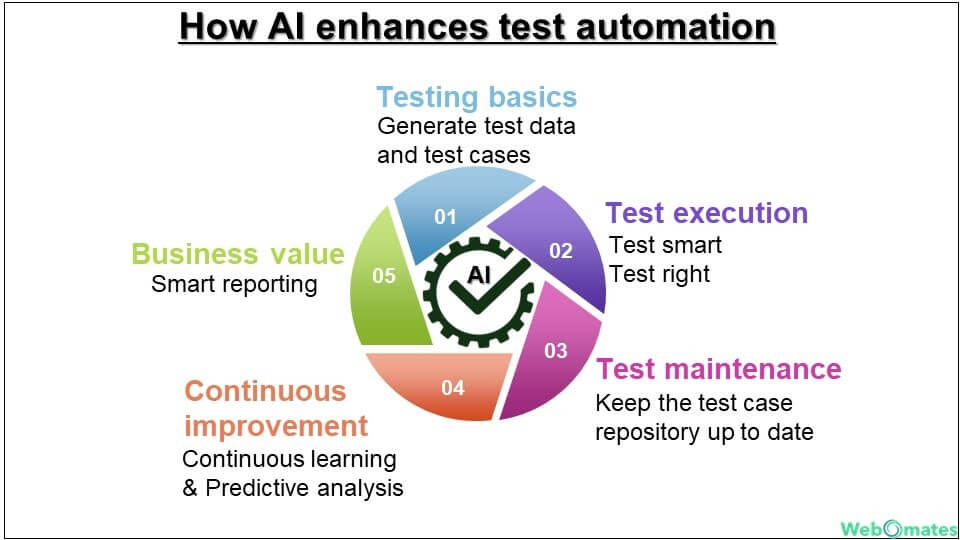
How Generative AI Can Be Used for Creating Test Cases and Test Data?
Getting the basics right is a good start for the testing process. Test data generation and test case generation is an important task and needs to be done with utmost care.
Understanding, analyzing, and then translating the requirements to test cases is a time-consuming job. AI-based tools can do it for you in less time and you can redirect your effort for other tasks.
With continuous testing, the amount of data generated, aggregated over multiple cycles, is huge. Sifting through that data, analyzing the patterns and trends to act as feedback for the next cycle is a herculean task. Also, the input data and test cases need to be updated with every cycle and have to be in sync with the requirements. Using AI/ML shares the load and does the maximum job by generating test data and test cases by learning from previous data/reports and incorporating the new requirements.
How AI Helps in Test Execution?
- Test Smart – It is not feasible to execute the whole test suite for the smallest of the changes made in the application under test. A smart strategy would be to identify the test cases that are directly impacted by the change and execute them. But with Continuous integration and testing, it becomes increasingly challenging to do that. Intelligent test automation comes to the rescue by analyzing the data from previous test cycles and identifying the right test cases to be executed for the changes done. This saves significant time and effort.
- Test Right – False failures are the bane of test automation. These are the scenarios when the test automation tool ends up marking a true pass case as a failure. Do take out some time to read our blog “Test automation challenges – False failures” to understand this better.
False failures can lead to unnecessary delays in the schedule because every failed test case needs to be triaged and based on its priority needs to be addressed accordingly. The issue of false failures can be addressed by applying AI/ML algorithms to test automation. The analytical capabilities of AI ensure that the test cases are marked correctly as true pass or true fail by learning from patterns of test results of previous test cycles and new information for the current cycle. - Smarter Test Selection with AI – Instead of running every test in your suite, AI can prioritize which tests are most likely to detect bugs- based on code changes, historical data, and commit activity. This intelligent selection saves time, cuts down feedback cycles, and helps teams focus on the most critical areas. Techniques like reinforcement learning are being used to optimize test coverage while reducing execution time.
How to Maintain Test Automation with AI?
Maintaining the test case repository up to date is very important to ensure that all test results are reliable and definitive. The last thing that you would want is that the application crashes because you forgot to update the test case for the minor changes in requirement or bug rectification. Now, AI algorithms integrated with the test automation framework can understand these changes and effortlessly self-heal the tests and re-execute them within the same cycle, thus speeding up the entire testing process.
How AI can Help in Improving Testing?
Continuous learning from the results of continuous testing aids in continuous improvement of the Quality processes of the organizations.
Continuous testing involves executing multiple cycles of different types of testing. With each test cycle, the test data grows and makes the decision-making process difficult as the testing progresses further. AI/ML algorithms can continuously observe and learn from these test results and generate easily comprehensible reports. These algorithms are capable of predictive analysis and can proactively predict issues before they can reach any critical level.

How AI can Help in Predictive Analysis?
A detailed report helps the business and technical stakeholders in making better business decisions. So what exactly makes a report good enough?
- One that helps in quantifying risks
- One that prepares a summary of patterns and trends observed during testing
- One that is easily comprehensible by everyone and is not just numbers.
The challenge is to make sense of the mountain of data generated by continuous testing. Test automation can generate data and basic reports, but it cannot think and analyze. Intelligent test analytics not only helps in analyzing the test results and generating reports but sends real-time alerts to all the stakeholders to bring them up to speed. You can read our blog on intelligent test analytics for better insights.
Recent studies support the use of AI for predictive testing. Machine learning models trained on historical test and defect data have shown improved accuracy in identifying risk areas and forecasting potential failures. This research-backed approach aligns with our mission to enable smarter, data-driven QA decisions.
How Webomates can Help?
Webomates CQ is an ingenious AI-based testing tool that delivers all of the above with the service level guarantees to support its claims.
Webomates provides intelligent automation solutions with intelligent analytics. It leverages the power of data processing, analysis, reasoning, and machine learning to provide an end-to-end testing solution for your business.
If you are looking for a one-stop solution for your testing needs then look no further, reach out to us at info@webomates.com.
If you liked this blog, then please like/follow us Webomates or Aseem
FAQs
AI Test Automation uses artificial intelligence to make test creation, execution, and maintenance smarter and faster. Unlike traditional automation- which follows hardcoded scripts- AI adapts to UI changes, learns from past failures, and can generate or heal test cases automatically.
Agile and DevOps demand quick release cycles with minimal bugs. Intelligent test automation with AI helps teams test faster, catch more issues early, and reduce maintenance time- without slowing down development.
As applications evolve, test cases can quickly become outdated. AI enhances test automation by identifying changes in the app, adapting test scripts, and prioritizing the most critical tests- helping QA scale alongside development without breaking the workflow.
Not entirely. AI can handle repetitive and predictable testing with speed and accuracy, but manual QA is still valuable for exploratory testing, usability checks, and complex edge cases. The real strength is in combining both.
With the right tools and platform, teams can start seeing value from AI Test Automation in just a few days. Many solutions are designed to plug into existing CI/CD pipelines with minimal disruption.
Yes. AI-based tools can actually be a big win for small teams- helping them automate faster without needing a large QA staff. It reduces the manual overhead and lets developers focus more on building features than fixing bugs.

Ruchika Gupta, COO and Co-founder of Webomates, has 20+ years of experience in product delivery and global tech operations. She has held key roles at IBM, SeaChange, IPC Systems, Birlasoft, and served as President of Fonantrix Solutions. She writes about scaling operations, building strong delivery teams, and enabling smarter testing practices.
Tags: AI-based testing, Artificial Intelligence, Intelligent Test Automation, TaaS, Test Automation
Leave a Reply