
Accelerate Success with AI-Powered Test Automation – Smarter, Faster, Flawless
Start free trial
The latest trends in Generative AI are revolutionizing industries by driving unprecedented levels of innovation, creativity, and productivity. In the world of software development, AI is reshaping test automation, enabling faster test generation, intelligent defect detection, and continuous quality assurance with minimal human intervention. Teams are now leveraging AI-powered tools to simulate complex user scenarios, analyze massive datasets in real time, and adapt tests dynamically based on code changes. The process helps teams move faster with releases while cutting down the chances of serious bugs making it into production.
The Future is Intelligent- AI Testing Trends to Look out for
Following are some of the current trends in the AI and ML software testing industry and how they are changing the game for software testing:
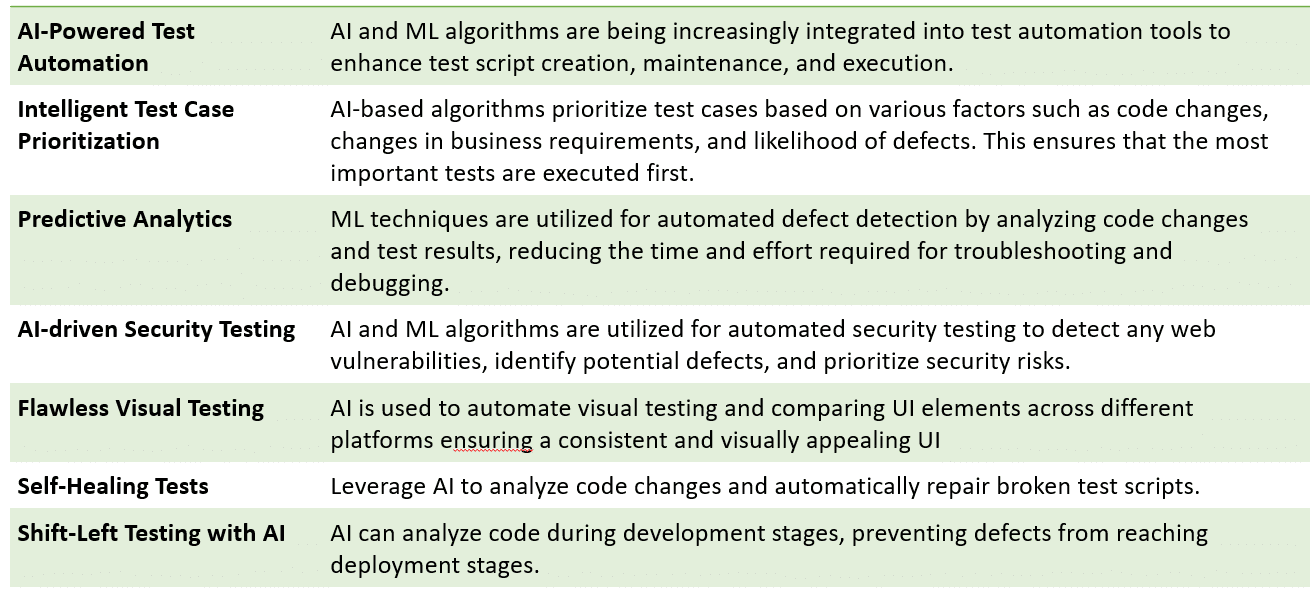
As AI and ML become more prevalent in software systems, developers and testers must keep up with these trends and tools in order to ensure the reliability and safety of these systems.
Key Criteria for Selecting the Best Intelligent/AI Automation Testing Platform
Before we dive into the details of various platforms available in the market, let’s take a quick look at the parameters you need to consider for selecting a testing platform. To evaluate the best fit for your team, you need to understand your business objectives and the differences in solutions offered by each service.
For guaranteed results, here is a list of evaluation criteria that you must ensure your testing platform will provide –
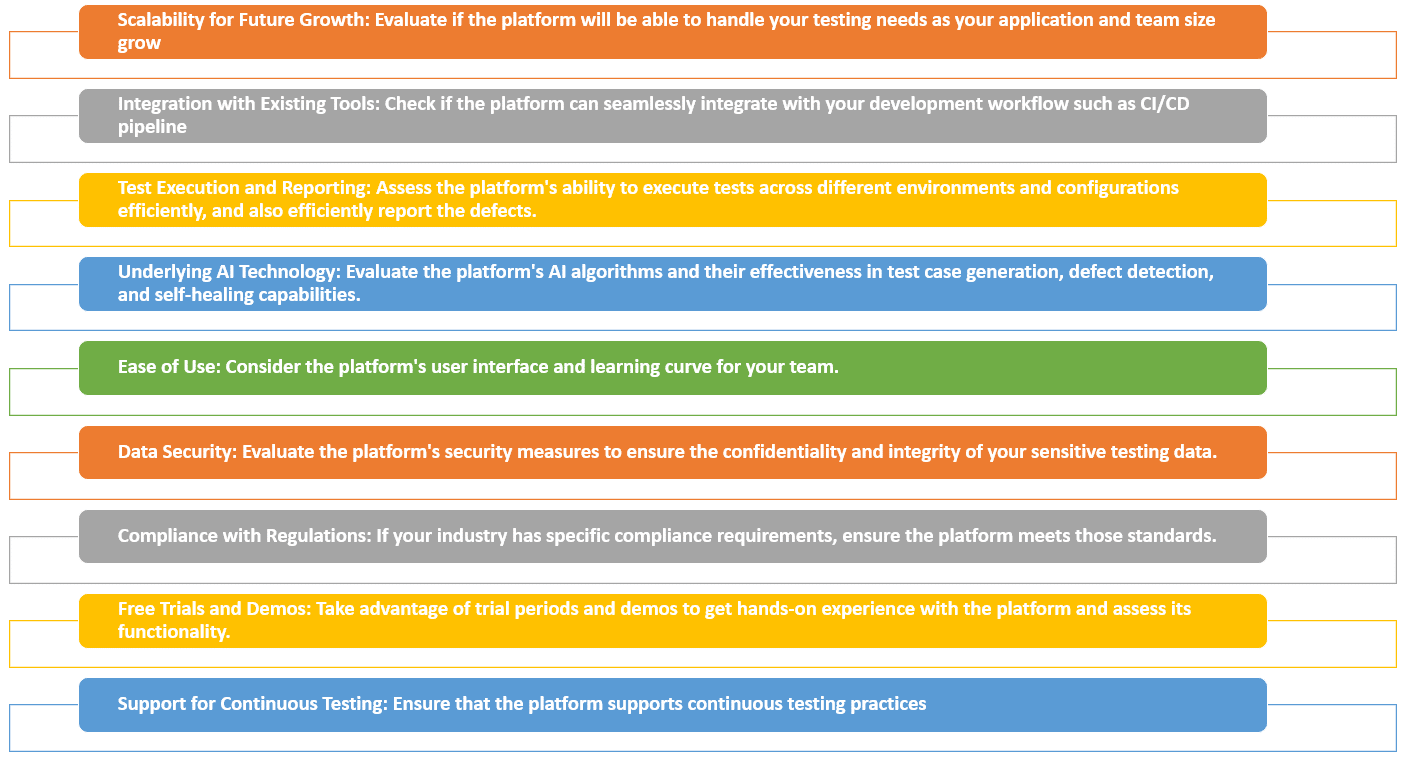
Ultimately, the best intelligent automation platform will depend on the specific needs and requirements of the organization or project. By carefully evaluating the above criteria and assessing the capabilities of different services, it will be possible to select the most suitable one for the task at hand.
The Top 5 Intelligent Test Automation Platforms/Services/Tools for You!
Automation testing tools are designed to automate repetitive tasks, reduce human error, and increase the coverage of the tests. However, not all automation testing tools are created equal, and choosing the best one for your organization can make a significant impact on the success of your testing efforts.
In this article, we will explore the innovative AI testing services/platforms/tools to look out for. These are the leaders in the market and they help organizations improve quality of their software while keeping costs at minimum.
Mabl
Mabl is an AI-powered test automation platform to easily create, run, analyze, and manage all of your functional UI and API tests.
The main features of mabl’s platform include:
- Test case design: Uses machine learning to automatically create and maintain tests.
- Auto-healing: The platform learns about your application with every test execution, capturing 35+ unique data points, which allows for the automatic detection and correction of errors or defects without human intervention.
- Data Insights: Insights are accessible and adaptable to your testing strategy. Teams can access customized insights in real-time with only a few clicks or a quick hover over a chart.
- API Testing: You can easily create and manage API tests.
- Continuous testing: Allows you to test continuously, by integrating with your CI/CD pipeline and allows you to schedule tests on a regular basis.
- Integrations: mabl’s platform can be integrated with other tools and services, such as Slack, Jira, and Jenkins.
- Functional and visual testing: mabl’s platform allows to perform both functional and visual testing, by checking the functionality of the web application and also the visual representation of the application.
Link – https://www.mabl.com/
Functionize
Functionize is an intelligent automation tool that combines the power of human insights and machine learning to automate the testing process, reducing the time and cost spent in testing while accelerating product releases.
The main features of Functionize’s platform include:
- AI-powered test automation: Creates AI-powered tests using Architect or plain English via natural language processing
- Test Maintenance : Reduces test maintenance time by 85% with self-healing tests
- Smart Element Detection – Eliminates visual test failures quickly & easily.
- Data Insights: Users can track their automated and manual test results from central dashboards in TestRail.
- Mobile testing: Supports mobile testing, allowing users to test web and mobile applications on multiple devices and platforms.
- Cloud-based testing: Allows to perform testing on the cloud, by having access to a variety of browsers, devices, and environments.
Link – https://www.functionize.com/
Webo.ai
False failures are one of the biggest frustrations in automation testing.. These failures are not defects but false positives, and a retest with an update to the test cases or test script is required. Fixing these “false positives” often tales weeks to resolve. But with Webomates’ trademarked “AiHealing® ” it is reduced to less than a day!
Webomates leverages the power of its patented AI technology of 14 AI tools to create hundreds or thousands of test cases and scripts and execute them using multiple testing execution techniques like AI automation, and AiHealing®.
Promising features of Webo.ai include:
- Rapid Onboarding and setup: Just 2 minutes of your time and your application is onboarded. Get working automation within 3 business days.
- Leverages power of generative AI: Generates test strategy and test cases within 1 business day of onboarding the application
- On Demand Regression Testing: Run FULL and Overnight test cycles and get detailed results with visual artifacts.
- Predictive Defect Reporting: Leverages machine learning algorithms and AI techniques to predict defects, identify potential risks or opportunities, and inform data-driven decision-making
- Cross-browser testing for UI and functionality: verifies if your website works as intended across different combinations of web browsers, operating systems, and devices.
- Comprehensive Test Coverage: With AI-based automated testing, one can increase the overall depth and scope of tests resulting in software quality improvement
- AiHealing® : “AiHealing®” addresses false failures by identifying and fixing false positives in the test automation. It also keeps the test automation updated.
- No worries about Test case Maintenance: Webomates’ self-healing test automation framework uses AI and ML algorithms, allowing the testing scope to be dynamically adjusted to the changes.
- Easy on pocket: Total cost of ownership is much less than other platforms available in the market since the efforts and resources consumption goes down dramatically
Link – https://www.webo.ai
Rainforest QA
Rainforest QA is a no-code testing platform for automated and manual QA testing. It provides AI-assisted testing with QA expertise for end-to-end testing of enterprise software platforms and web applications. It also combines functional, exploratory and visual testing in every test step.
Some of the key features include:
- Automated Test creation: Uses Generative AI to quickly create automated test scripts
- Self-healing tests: It automatically updates the relevant tests to reflect intended changes to your app.
- Test run parallelization: It allows you to execute comprehensive test cases. The automation can run 100s of tests in parallel on the cloud-based infrastructure of virtual machines.
- Defect logs: For every defect, video replay, repro steps, browser logs, and HTTP logs are shared.
- Codeless platform: the platform requires zero code to write, run, and maintain end-to-end tests.
- Integration: Rainforest integrates with email, Slack, and MS Teams for important notifications, and integrates with JIRA for automatic generation of bug tickets.
Link – https://www.rainforestqa.com/
Applitools
Applitools is an Intelligent Testing Platform that allows for dynamic authoring of tests with AI. It’s particularly beneficial for large websites and applications that are content-rich or frequently updated. Applitools can run anywhere – on your cloud, behind a firewall, or as our own public SaaS.
The main features of Functionize’s platform include:
- Automated Testing: Applitools automates the entire testing process, from test creation to maintenance, using AI.
- Continuous Testing: By integrating seamlessly into CI/CD pipelines, Applitools enables continuous testing and monitoring.
- Generative Testing: Automatically creates test cases for your site using Generative AI
- Visual AI: Validates thousands of UI elements instantly, improving test coverage and reducing manual testing efforts.
- Contextual UI Testing: Enhances test reliability by leveraging contextual and semantic cues from the UI.
- Test Any Interface: Validate any type of UI, including components, applications, PDF documents – on any screen or device.
Link – https://applitools.com/
Testim by Tricentis
Testim is an AI-powered test automation platform that helps teams quickly author, execute, and maintain reliable end-to-end tests for web applications.
The main features of Testim’s platform include:
Test case design: Testim uses artificial intelligence to accelerate the creation of stable tests. Its smart locators adapt to UI changes, making test scripts more resilient and less prone to breakage.
Self-healing tests: Testim identifies changes in the application and automatically updates locators during test execution, significantly reducing manual maintenance efforts.
Fast execution: Testim supports parallel test runs in the cloud or locally, allowing teams to execute thousands of tests quickly and scale testing with demand.
Customization: Testim offers both a low-code interface and the flexibility of JavaScript for custom logic, making it ideal for both testers and developers.
CI/CD integration: The platform integrates seamlessly with DevOps pipelines and popular CI/CD tools like Jenkins, CircleCI, and GitHub Actions.
Collaboration and version control: With built-in Git integration and team workspaces, Testim enables efficient collaboration, version tracking, and test management.
Reporting and analytics: Rich dashboards and detailed reports help teams analyze test results and monitor trends over time to improve quality.
Conclusion
AI-driven test automation isn’t just a nice-to-have anymore; it’s become essential for keeping up with the speed and complexity of modern software development. As applications grow more complex and release cycles shorten, organizations rely on intelligent automation to maintain quality, reduce manual effort, and detect issues early in the development process.
Choosing Your Ideal Testing Partner. Automation testing is a crucial step in the software development process, ensuring that your products are of the highest quality and free of bugs before release. However, it can be challenging to choose the best automation testing service for your project because there are numerous options available.
Before diving into specific tools, take a moment to assess your unique testing environment. The size and intricacy of your project will influence the level of testing required. You must conduct a detailed analysis in terms of ease of use, reporting, and integration with various tools. You can also consider:
- Free Trials and Demos: Take advantage of free trials and demos to test-drive different tools and services. This hands-on experience is invaluable for assessing fit and functionality.
- Scalability and Integration: Consider the tool’s ability to scale with your project and integrate with your existing development workflow.
- Community and Support: A strong community and reliable support system can be invaluable for troubleshooting and ongoing learning.
By carefully assessing your needs, exploring your options, and selecting the right tools, you can build a robust testing strategy that delivers high-quality software, faster.
If you’ve worked with any of them before, share your thoughts in the comments.
FAQs
AI-powered testing tools offer self-healing capabilities that automatically adjust to changes in the application’s UI or code without requiring manual updates, unlike traditional automation, which often breaks and demands high maintenance. By analyzing usage patterns, past bugs, and code changes, these tools can intelligently generate and optimize tests, focus on high-risk areas, reduce false positives and negatives, and lower maintenance workload.
Platforms like Webomates take this a step further by combining AI, automation, and crowdsource testing to deliver high-quality results with minimal manual effort. AI-driven solutions also provide deeper insights into test performance, flakiness, and risk areas, supporting more informed testing strategies. These tools are especially effective in handling dynamic, complex applications where traditional automation often falls short.
AI-powered test automation tools maintain test cases through self-healing capabilities that automatically adapt test scripts when an application changes. These tools monitor for modifications in the UI or code and use AI algorithms to adjust test steps, selectors, and other elements accordingly, preventing failures without manual intervention. For example, if a button’s position or selector changes, the AI updates the script to reflect the change, ensuring test accuracy.
In addition to maintenance, AI improves testing through intelligent test prioritization and execution by analyzing historical data, defect patterns, and code changes to focus on high-risk areas. This automation reduces manual effort, allowing QA teams to concentrate on strategic tasks while accelerating feedback loops through integration with CI/CD pipelines for continuous testing. A solution like Webomates harnesses these AI-driven capabilities to streamline test management and improve software quality at scale.
Yes, AI platforms can predict which defects are most critical by analyzing historical defect data, test results, code changes, and user behavior. Using machine learning, they identify patterns and assign risk scores based on factors like severity, frequency, and impact on key functionalities. Some platforms also integrate with bug tracking tools to provide real-time prioritization, helping teams focus on the most high-risk issues.
This improves testing efficiency, reduces time spent on low-impact bugs, and supports faster, more reliable releases. Webomates applies these AI-driven techniques to continuously evaluate defect risk and optimize testing focus. By doing so, it helps QA teams catch critical issues early and deliver higher-quality software with confidence.
No, you don’t need AI expertise to use Webomates or similar AI-driven testing tools. These platforms are designed to be user-friendly and accessible to QA professionals, developers, and product teams without requiring deep knowledge of machine learning or data science. Webomates, for example, abstracts the complexity of AI by providing intuitive dashboards, automated workflows, and easy integration with existing CI/CD pipelines.
The AI works in the background to handle tasks like test generation, prioritization, self-healing, and defect analysis. This allows teams to benefit from advanced AI capabilities while focusing on their core testing and development work.
AI-driven testing tools like Webomates typically offer a range of security and compliance features to ensure data protection and meet industry standards. These include secure data transmission using encryption such as HTTPS and TLS, access control mechanisms like role-based permissions, and strong authentication methods to protect user accounts and test environments.
Many platforms also support compliance with industry regulations such as GDPR, HIPAA, SOC 2, and ISO 27001, depending on the sector they serve. Test data is often anonymized or masked to prevent exposure of sensitive information, and detailed audit logs are maintained to track all testing activities. Additionally, secure integration with enterprise tools like Jira, Jenkins, and Git helps ensure that workflows remain compliant and protected across the development lifecycle. Webomates, for instance, follows enterprise-grade security practices and regularly undergoes third-party audits to validate its compliance and safeguard customer data.

Ruchika Gupta, COO and Co-founder of Webomates, has 20+ years of experience in product delivery and global tech operations. She has held key roles at IBM, SeaChange, IPC Systems, Birlasoft, and served as President of Fonantrix Solutions. She writes about scaling operations, building strong delivery teams, and enabling smarter testing practices.
Tags: AI Test Automation Platforms, AI Testing, Test Automation, Test Automation Platforms
Leave a Reply