
Accelerate Success with AI-Powered Test Automation – Smarter, Faster, Flawless
Start free trial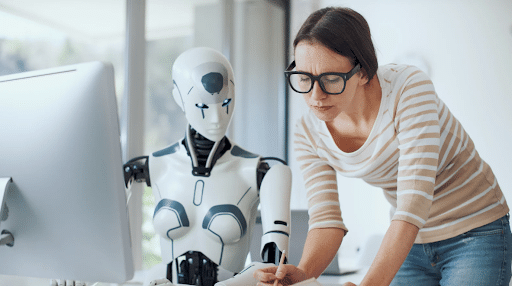
Yes – AI is powerful.
But – AI can also hallucinate.
This isn’t a human vs. AI war. AI can generate test scripts and test data in seconds, identify trends, and potential defects. But without human oversight, it can also produce false positives, suggest irrelevant tests, or miss business expectations. So yes – Trust, but verify!
How AI Changes the Tester’s Role
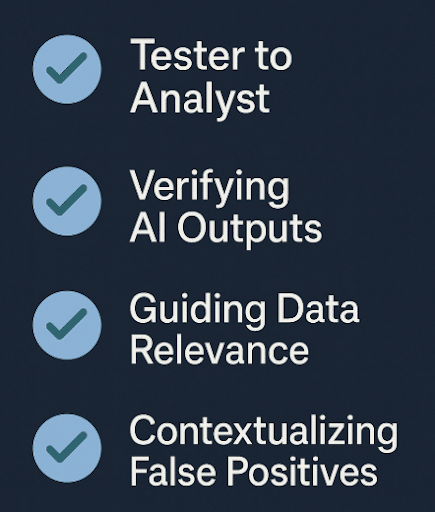
As AI tools continue to mature, the tester’s role will increasingly resemble that of an analyst or a quality strategist, verifying AI outputs, guiding data relevance, and contextualizing false positives.
1. Tester to Analyst
AI can accelerate you to your destination, but it doesn’t always know the best route. AI can automatically generate the test cases and test data, but needs a quality check to ensure relevance.
The most impactful testers will be those who can shift their role from “creation” to “verification and validation”, ensuring that the machine-generated output aligns with business goals, user behavior, and real-world edge cases.
2. Verifying AI Outputs
Human testers don’t just run tests; they understand the “why” behind user behavior. The human-in-the-loop approach ensures that:
- Test cases match the actual user experience.
- Critical business logic is checked for exceptions.
- Business-critical scenarios are always included.
- Redundant or duplicate test paths are removed.
- All regulatory or compliance nuances are followed.
3. Guiding Data Relevance
AI can only do what it is programmed to do, and its outputs are only as good as the data it’s trained on or prompted with. Inaccurate or incomplete data can also lead to a biased model.
Hence, it is necessary to review the generated test cases to ensure the test case is structured and is relevant, has clear and accurate test steps, and consistent and maintainable automation scripts. They guide the system toward data that matters, not just data that’s available.
4. Contextualizing false positives
False failures can be due to script interaction with the browser, locator changes, or dynamic behavior of the application. Some of this complexity can be handled at the script level, but correctness can’t be 100%.
Testers interpret whether the failure has any real user impact. They use their domain knowledge, filter out false positives, and analyze test results with business logic. They make judgment calls that no algorithm can replicate. They ensure that the output isn’t just smart, but is also accurate.
Webomates: The Future is Hybrid, Not Human-Free
That’s what we do at Webomates – we harness the incredible speed and scale of generative AI to accelerate test creation, regression cycles, and defect triaging. But we also never forget this golden rule: “Trust, but verify.”
That’s why we blend the power of generative AI with the critical judgment of our experienced testers to ensure only the highest quality of test cases is delivered to the user.
We have a step for checking the outputs by our experienced testers.
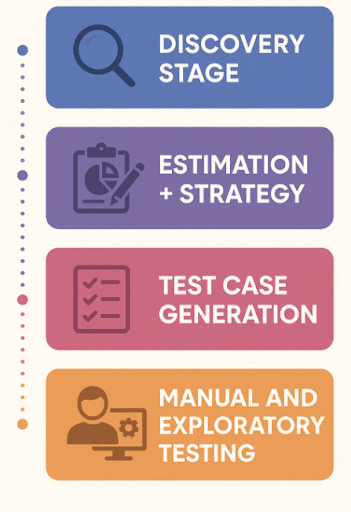
- Discovery stage: Review and refine test coverage with domain knowledge and business-specific understanding.
- Estimation + Strategy: Validate that the testing strategy aligns with business expectations, regulatory requirements (especially in domains like Healthcare or Fintech), unscripted paths, and edge-case scenarios. It ensures that unscripted paths and edge-case scenarios are factored into the plan, areas where automation alone may fall short.
- Test Case Generation: Review the generated test cases to ensure business logic is intact and all domain-specific test cases are covered.
- Manual and Exploratory Testing: Some areas, such as complex UI components, usability workflows, or nuanced user behavior, still require human intuition and require manual testing and exploratory testing.
The platform enables teams to accelerate their time-to-market by providing the framework, tooling, and accelerators to test their application across any industry type.
Click here to schedule a demo. You can also reach out to us at info@webomates.com.
AI Won’t Replace Testers—But It Will Replace Outdated QA
Move beyond manual execution. Use AI-driven testing to automate repetitive tasks, gain deeper insights, and focus on what truly matters—quality, strategy, and smarter releases.
✔ No credit card required | ✔ Get started in minutes
FAQs
AI is changing the role of software testers by automating many of the time-consuming tasks like test case creation, defect prediction, and regression testing. Instead of spending hours on repetitive checks, testers now use AI tools to detect patterns, analyze results faster, and maintain test coverage even as software changes.
This shift allows them to focus more on important tasks like understanding user behavior, assessing risks, and ensuring overall product quality. Simply put, AI is turning testers into quality analysts and decision makers instead of just manual executors.
Testers verify AI-generated outputs by checking if the results actually make sense in real testing conditions. AI can create test cases, detect patterns, or flag potential defects, but it doesn’t always understand business rules, user behavior, or exceptions. This is where the support of human testers is required to review these outputs, like validating logic, removing duplicates, checking data relevance, and confirming that the AI’s result aligns with actual user scenarios and business requirements.
At Webomates, this balance between AI and human judgment is built into the process. While AI accelerates test creation, defect analysis, and regression runs, testers review each output to ensure accuracy and context. This hybrid approach ensures that what AI delivers is not just fast, but right.
AI can sometimes misread dynamic behavior or minor interface changes as defects. Testers then interpret these alerts and check whether the issue actually affects the user journey or business logic. Using their domain understanding and context, they filter out the false flags, adjust test scripts if needed, and ensure that the final results focus only on genuine risks.
Webomates follows this human-in-the-loop approach, wherein AI identifies potential issues, while human testers validate them to ensure that only meaningful results are delivered.
AI-driven testing changes the focus from manual execution to smart interpretation. Testers now need a mix of technical, analytical, and domain skills to work effectively with these AI tools. They should understand how AI models make decisions, how to read and interpret AI-generated data, and how to spot when something doesn’t align with the actual user behavior.
They also need sharper skills in data analysis, scripting, test strategy, and critical thinking, along with the ability to question AI outputs, validate assumptions, and guide the system with human context and judgment.

Aseem, Founder & CEO of Webomates, created Webomates CQ, an AI-driven testing platform that cuts testing time by 10x with AiGenerate , and accelerates test maintenance by 10x using AiHealing, with guaranteed 24-hour execution. A multi-technical Emmy award winner with AI automation patents, he writes about AI-first testing and faster, simpler software delivery.
Tags: AI in Software Testing, AI Testing, ai testing automation, Hybrid Testing Approach, Software Testing
Leave a Reply