
Accelerate Success with AI-Powered Test Automation – Smarter, Faster, Flawless
Start free trial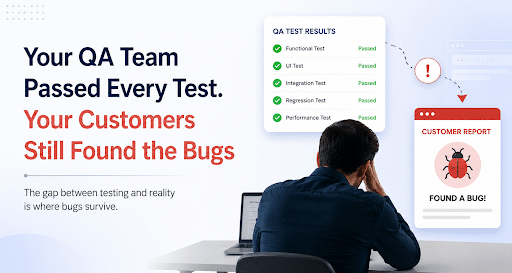
I’ve sat in enough release retros to know the pattern by heart. The dashboard is green. Every regression suite passed. The team did the demo, everyone nodded, the release shipped on a Thursday afternoon like it was supposed to.
By Monday, support tickets are piling up about something nobody tested for – a checkout flow that breaks on a specific carrier’s network, a dashboard that times out for the one customer running 40,000 records instead of 400.
If you’ve led an engineering org, a product org, or a P&L that depends on either, you already know this story doesn’t end with “we’ll add a test case.” It ends with you, in a board meeting, explaining why a “fully tested” release is now costing you renewals.
That gap – between “tests passed” and “customers are fine” – is exactly what shift-right testing exists to close. And the piece that makes shift-right testing actually work, instead of just looking good on a slide, is end-user feedback. Let me walk you through why.
What Shift-Right Testing Actually Means
Shift-right testing is the practice of continuing to validate software quality after release, inside the live production environment, using real users, real traffic, and real data instead of simulated test scenarios.
Where shift-left testing front-loads quality checks into design and development to catch defects before they’re expensive, shift-right testing accepts a harder truth: no staging environment, however good, fully recreates the chaos of real customers doing unpredictable things on real devices, real networks, and real data volumes.
Shift-right typically shows up as:
- Canary releases – rolling a change out to a small slice of real users before the rest of the base
- A/B testing – comparing how real users behave against two live variants
- Feature flags and progressive delivery – exposing new functionality gradually and watching what happens
- Real user monitoring (RUM) – capturing actual performance and error data from live sessions
- Chaos and fault-injection testing – deliberately breaking things in production to see how the system recovers
- End-user feedback loops – direct signal from the humans actually using the product
Most companies stop at the first five. The sixth is where the real ROI lives – and it’s the one most testing strategies leave on the table.
The Blind Spot Shift-Left Alone Can’t Close
Shift-left testing is not wrong. It’s necessary. Catching a defect in design or during development costs a fraction of what it costs to catch the same defect after a customer hits it in production – that math hasn’t changed in twenty years and it isn’t going to.
But shift-left has a structural limit: it can only test for the behaviors someone thought to write a test case for. Your QA team is smart, but they are not your 50,000th customer, on a five-year-old Android phone, on a throttled connection, halfway through a workflow they invented themselves because your UI didn’t quite match their mental model.
That’s not a testing failure. That’s a coverage ceiling. No amount of additional pre-release test cases changes the fact that production is the only environment where your actual users generate your actual edge cases.
End-User Feedback Is the Missing Half of Your Quality Strategy
Here’s where most shift-right conversations stop short. Teams will tell you they monitor production – dashboards, alerts, latency graphs, error rates. That’s observability, and it matters. But observability tells you what broke. It rarely tells you why it mattered to the user, or what almost broke but just left someone frustrated enough to churn quietly without ever filing a ticket.
End-user feedback closes that gap. It’s the difference between:
- A latency spike showing up on a graph, versus a user telling you the checkout felt “broken” and they abandoned the cart
- An error rate ticking up 0.3%, versus a support transcript revealing that 0.3% is concentrated entirely among your highest-value enterprise accounts
- A feature flag rollout with no anomalies, versus in-app feedback showing users can’t find the feature you just shipped
Metrics tell you the system is technically functioning. Feedback tells you whether the experience is actually working. C-suite leaders who only look at the first one are flying with half the instrument panel lit.
How Shift-Right Testing with End-User Feedback Drives Continuous Quality Improvement
This is the loop I push every engineering and product leader I talk to: shift-right testing isn’t a phase you complete. It’s a closed circuit that runs continuously, and it works in four moves.
- Release with controlled exposure. Canary, feature flag, or A/B – you limit the blast radius while still getting real signal.
- Observe technical behavior. Performance, error rates, crash data – the telemetry layer.
- Listen to the human layer. In-app feedback, support signals, session replay, satisfaction scores – the experience layer.
- Feed both signals back into the next build. Not as a backlog item that dies in triage, but as a prioritized input into what gets fixed, refined, or expanded next.
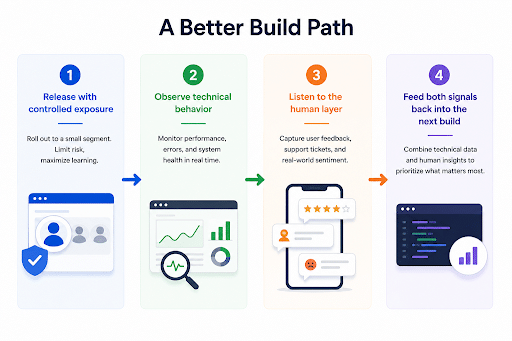
Then you repeat it. Every release becomes a small experiment that makes the next release smarter. That’s what “continuous quality improvement” actually means in practice – not a one-time initiative, but a habit your engineering org builds into its muscle memory.
The companies that get this right don’t treat production feedback as a fire alarm. They treat it as R&D they’re getting for free, straight from the only group of people whose opinion of your product actually decides your retention numbers.
Shift-Left vs. Shift-Right: Where Each One Earns Its Keep
| Shift-Left Testing | Shift-Right Testing | |
| When it happens | Before release, during design and development | After release, in live production |
| What it catches | Logic errors, code defects, known scenarios | Real-world usage patterns, scale issues, unanticipated behavior |
| Primary signal | Test case pass/fail | Telemetry + end-user feedback |
| Cost to fix a defect | Lowest | Highest – but unavoidable for production-only issues |
| Best for | Preventing the majority of defects | Catching what prevention couldn’t anticipate |
Neither column wins on its own. The companies shipping the most reliable software run both simultaneously, with feedback flowing between them instead of testing stopping at the deployment line.
The Cost of Getting This Wrong
Capgemini’s global quality research has consistently found that more than half of QA leaders believe their traditional testing approach misses critical risks that only surface in production. That’s not a fringe opinion – that’s the majority of the people whose job it is to know.
For a C-suite audience, the real cost isn’t abstract. It’s the renewal that doesn’t close because a customer hit a bug your dashboards never flagged. It’s the support team absorbing tickets that engineering never sees framed as product input. It’s the slow leak of churn that never shows up as a single dramatic incident – just a quiet erosion that looks, in hindsight, exactly like “we were testing the wrong things.”
How We Operationalize This at Webomates
This is the exact reason we built Webomates CQ the way we did. Shift-left and shift-right aren’t separate products in our world – they’re one continuous quality pipeline.
- AiGenerate cuts test creation time so your team isn’t choosing between writing new tests and analyzing production feedback – they have time for both.
- AiHealing keeps your regression suite current automatically, so the moment production feedback tells you to change a flow, your tests adapt instead of breaking.
- AI Defect Predictor triages true failures from false positives, so when real-world signal comes in, your team is chasing actual defects instead of noise.
- Guaranteed 24-hour execution means feedback from production doesn’t sit in a queue – it gets validated and acted on at the speed your release cycle actually moves.
The point isn’t the feature list. The point is that quality stops being a gate you pass through once and becomes a feedback loop that compounds, release after release.
A 5-Point Checklist for Your Next Leadership Review
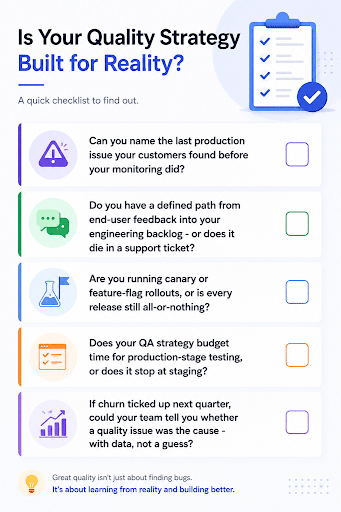
- Can you name the last production issue your customers found before your monitoring did?
- Do you have a defined path from end-user feedback into your engineering backlog – or does it die in a support ticket?
- Are you running canary or feature-flag rollouts, or is every release still all-or-nothing?
- Does your QA strategy budget time for production-stage testing, or does it stop at staging?
- If churn ticked up next quarter, could your team tell you whether a quality issue was the cause – with data, not a guess?
If more than one of these makes you pause, that’s not a failure. That’s a roadmap.
Let’s Talk About What This Looks Like for Your Stack
I’d rather show you this than describe it further. If you want to see how shift-right testing with real end-user feedback would slot into your existing release process – and where it would catch what your current testing doesn’t – let’s get 20 minutes on the calendar. [Schedule a walkthrough with our team] and bring your toughest recent production incident. We’ll work through it live.
Frequently Asked Questions
What is shift-right testing in simple terms? Shift-right testing means continuing to test and validate your software after it’s live, using real users and real production conditions, instead of stopping all validation at the moment of release.
How is shift-right testing different from shift-left testing? Shift-left testing happens before release to prevent defects early, when they’re cheapest to fix. Shift-right testing happens after release to catch the issues that only appear under real-world conditions – real traffic, real devices, real user behavior – that no staging environment can fully replicate.
Why does end-user feedback matter more than just monitoring metrics? Monitoring tells you a system is technically functioning. End-user feedback tells you whether the experience actually works for the person using it. A system can show healthy metrics while users are quietly frustrated and churning – feedback is what surfaces that gap.
Do we need both shift-left and shift-right testing, or can we pick one? You need both. Shift-left reduces the number of defects that ever reach production. Shift-right catches the residual issues – usage patterns, scale behaviors, edge cases – that only show up once real users are in the system. Companies running only one approach are leaving a known category of risk uncovered.
What’s the fastest way to start shift-right testing without disrupting our release process? Start small: pick one upcoming feature, roll it out as a canary release to a limited user segment, pair it with a lightweight in-app feedback prompt, and route both the technical and experience signal into the same review. You don’t need a full platform overhaul to start the feedback loop – you need one disciplined pilot.
How does Webomates support shift-right testing for enterprise teams? Webomates CQ pairs AI-driven test generation and self-healing automation with rapid, guaranteed-turnaround execution, so production feedback can be validated and acted on quickly instead of sitting in a backlog. The platform is built to keep shift-left and shift-right working as one continuous quality loop rather than two disconnected efforts.

Aseem, Founder & CEO of Webomates, created Webomates CQ, an AI-driven testing platform that cuts testing time by 10x with AiGenerate , and accelerates test maintenance by 10x using AiHealing, with guaranteed 24-hour execution. A multi-technical Emmy award winner with AI automation patents, he writes about AI-first testing and faster, simpler software delivery.
Tags: Continuous Quality Improvement, Continuous Testing Enterprise, DevOps, End User Feedback, Enterprise QA, QA Strategy, Quality Assurance, Shift-Right Testing, Software Testing, Test Automation, User Experience
Leave a Reply