
Accelerate Success with AI-Powered Test Automation – Smarter, Faster, Flawless
Start free trial
AI in software testing has moved from experimental pilots to board-level priority. Enterprises are no longer asking whether to adopt artificial intelligence in testing; they are asking how to scale AI test automation without increasing operational risk.
In 2026, the real conversation is no longer about hype. It is about outcomes. What actually works in AI in testing at enterprise scale? What are the limitations of AI test automation? Why does AI testing fail in enterprises? And most importantly, how do you scale AI in QA responsibly?
This guide separates signal from noise.
The Enterprise Reality of AI in Software Testing
Enterprise teams operate under constraints that most AI testing tools were never designed for: legacy systems, distributed DevOps pipelines, regulatory compliance, fragmented data, and multi-product architectures.
AI in DevOps has accelerated release cycles. Continuous testing with AI is now expected. But scaling enterprise test automation requires more than intelligent demos. It demands resilient systems.
Machine learning in software testing has matured in narrow domains. However, test automation at scale exposes weaknesses in AI models that were trained in controlled environments but deployed into complex enterprise ecosystems.
This is where many organizations encounter their first wave of AI testing implementation challenges.
What Actually Works in AI in Testing at Enterprise Scale
Despite the noise, certain applications of AI test automation consistently deliver a measurable ROI of AI in testing.
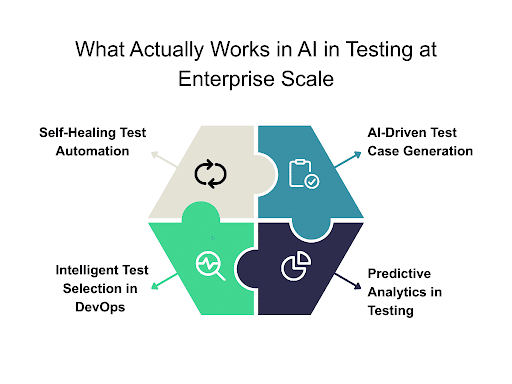
1. Self-Healing Test Automation
Self-healing test automation has proven effective in large regression suites. By dynamically adjusting locators and adapting to UI changes, it reduces brittle failures and lowers maintenance costs.
At scale, this directly impacts enterprise test automation stability. It does not eliminate engineering oversight, but it meaningfully reduces repetitive repair work.
2. AI-Driven Test Case Generation
AI-driven test case generation, particularly with generative AI in testing, accelerates coverage expansion. An LLM in software testing environments can analyze user stories, logs, and historical defects to propose edge cases.
However, enterprise teams that succeed treat AI-generated tests as drafts, not final artifacts. Intelligent test automation requires validation layers.
3. Predictive Analytics in Testing
Predictive analytics in testing is one of the most powerful enterprise use cases. By analyzing defect concentration patterns, AI can prioritize high-risk modules before release.
This improves risk-based continuous testing with AI and enables smarter release gating inside DevOps pipelines.
4. Intelligent Test Selection in DevOps
AI-powered test automation tools increasingly optimize execution time through selective test runs. In complex CI/CD environments, this dramatically improves pipeline efficiency.
When implemented properly, AI for QA reduces feedback loops without sacrificing release confidence.
Why AI Testing Fails in Enterprises

For every success story, there are quite a few failures.
1. The Limitations of AI Test Automation
AI test automation struggles with highly dynamic workflows, deep integrations, and non-deterministic systems. Autonomous testing remains aspirational in most enterprise contexts.
What is marketed as “autonomous testing” often requires heavy supervision and manual override at scale.
2. AI Testing Implementation Challenges
Common enterprise challenges include:
- Data silos are preventing effective machine learning in software testing
- Governance gaps around AI decision-making
- Compliance restrictions limiting model training
- Legacy system constraints are incompatible with AI-driven tooling
These structural issues explain why AI testing fails in enterprises even when pilot projects look promising.
3. False Confidence from Automation Metrics
High automation percentages do not equal high quality. Intelligent test automation must be measured by defect escape reduction and risk mitigation, not script count.
Generative AI in Testing: Signal vs Hype
Generative AI in testing and LLM in software testing have introduced powerful capabilities, particularly for AI-driven test case generation and documentation analysis.
But enterprises must acknowledge the risks:
- Hallucinated scenarios
- Context loss across complex workflows
- Overconfidence in AI-suggested coverage
AI-powered test automation tools that integrate generative models need strict validation loops. Without guardrails, artificial intelligence in testing can amplify errors at scale.
How to Scale AI in QA Without Increasing Risk
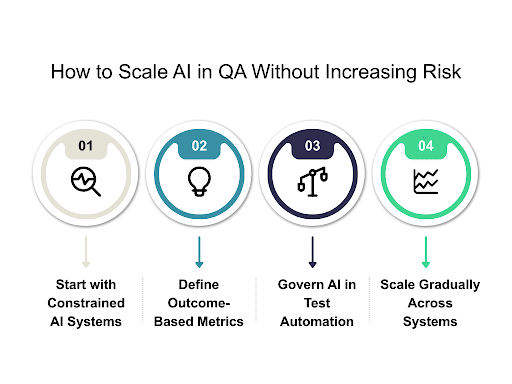
Scaling AI in QA requires discipline.
1. Start with Constrained AI Systems
Instead of deploying AI across the entire testing lifecycle, successful enterprises begin with narrow, measurable use cases such as self-healing test automation or predictive analytics in testing.
This reduces implementation risk and clarifies the ROI of AI in testing.
2. Define Outcome-Based Metrics
To measure the ROI of AI in testing, track:
- Defect escape rate
- Maintenance cost per release
- Automation resilience
- Prediction accuracy
Outcome-driven metrics expose whether AI test automation is strengthening or weakening quality systems.
3. Govern AI in Test Automation
AI in DevOps must include auditability, override mechanisms, and clear ownership. Artificial intelligence in testing should enhance engineering judgment, not obscure it.
4. Scale Gradually Across Systems
Test automation at scale demands infrastructure alignment. AI testing implementation challenges multiply when expansion outpaces architectural readiness.
Is AI Replacing QA Engineers?
One of the most common long-tail questions is: Is AI replacing QA engineers?
The answer is no.
AI for QA automates execution and improves signal detection. It does not replace contextual reasoning, system-level thinking, or risk judgment.
In fact, enterprises scaling AI in software testing often require more skilled engineers, not fewer, to interpret AI output and manage complexity.
AI is augmentative, not autonomous.
Enterprise AI Testing Metrics That Matter
Leadership teams evaluating AI in software testing should prioritize:
- Automation resilience rate
- AI-driven risk reduction trends
- Defect prediction accuracy
- Test maintenance cost trajectory
- Release confidence stability
These metrics reveal whether AI test automation is strengthening enterprise quality engineering systems.
The Future of AI in Software Testing
By 2026, AI in software testing will mature beyond surface automation.
We will see:
- More disciplined, intelligent test automation frameworks
- Smarter predictive analytics in testing
- Generative AI in testing is used with structured guardrails
- AI-powered test automation tools acting as decision-support systems
- AI in DevOps is evolving into a real-time quality intelligence layer
Autonomous testing will remain limited to constrained environments. Enterprise reality will favor supervised intelligence.
Conclusion: AI in Software Testing Is a Multiplier, Not a Shortcut
AI in software testing works at an enterprise scale when it strengthens systems. It fails when treated as a shortcut.
AI test automation delivers value through measurable risk reduction, improved pipeline efficiency, and lower maintenance drag. But scaling artificial intelligence in testing requires governance, discipline, and outcome-based measurement.
The enterprises that succeed in 2026 will not chase hype. They will scale AI in QA deliberately, measure ROI rigorously, and combine machine learning in software testing with strong engineering fundamentals.
AI is not replacing QA. It is amplifying it for those who implement it correctly.
If you’re exploring how to scale AI in software testing without increasing risk, the right operating model matters more than the right tool. Webomates helps enterprises implement AI-driven QA systems that deliver measurable risk reduction, not just automation metrics. Talk to our team about building intelligent, resilient enterprise test automation that actually scales.
Ready to move from AI experimentation to AI impact in QA?
Webo.AI enables enterprises to operationalize AI-driven testing with governance, intelligence, and measurable outcomes.
👉 Explore Webo.AI or schedule a demo to see how scalable, risk-aware AI testing works in the real world.
AI in Testing Works—Only If It Scales
From test creation to defect prediction, AI can transform QA—but only with the right strategy. Scale smarter with self-healing automation and intelligent insights.
FAQs
1. What actually works when scaling AI in software testing at the enterprise level?
At enterprise scale, AI in software testing works best in constrained, high-impact use cases such as self-healing test automation, predictive analytics in testing, AI-driven test case generation, and intelligent test selection in DevOps. These applications reduce maintenance drag, improve risk prioritization, and accelerate CI/CD pipelines. Enterprises see measurable ROI of AI in testing when outcomes focus on defect escape reduction and automation resilience. Success depends on disciplined implementation, not broad automation claims.
2. Why does AI testing fail in enterprises?
AI testing fails in enterprises due to governance gaps, legacy system constraints, data silos, and unrealistic expectations of autonomous testing. Many AI test automation tools perform well in pilots but struggle in complex, regulated ecosystems. Overreliance on automation metrics instead of risk reduction creates false confidence. Without structured validation and oversight, artificial intelligence in testing can amplify system fragility.
3. What are the limitations of AI test automation in 2026?
The limitations of AI test automation include difficulty handling non-deterministic workflows, deep integrations, and rapidly evolving enterprise architectures. Generative AI in testing can hallucinate edge cases or miss contextual dependencies. Fully autonomous testing remains limited to controlled environments. AI for QA enhances execution speed and signal detection but still requires human judgment and governance.
4. How can enterprises scale AI in QA without increasing operational risk?
Enterprises can scale AI in QA by starting with narrow use cases, defining outcome-based metrics, and implementing strong AI governance frameworks. Tracking defect escape rate, maintenance cost per release, prediction accuracy, and automation resilience ensures responsible scaling. AI in DevOps must include auditability and clear ownership. Gradual expansion aligned with infrastructure readiness prevents implementation instability.
5. Is AI replacing QA engineers in enterprise software testing?
AI is not replacing QA engineers in enterprise environments. Instead, AI-powered test automation augments engineers by reducing repetitive maintenance and improving defect prediction. Scaling machine learning in software testing increases the need for skilled professionals who can interpret AI outputs and manage risk. AI acts as a multiplier for quality engineering, not a substitute for expertise.

Aseem, Founder & CEO of Webomates, created Webomates CQ, an AI-driven testing platform that cuts testing time by 10x with AiGenerate , and accelerates test maintenance by 10x using AiHealing, with guaranteed 24-hour execution. A multi-technical Emmy award winner with AI automation patents, he writes about AI-first testing and faster, simpler software delivery.
Tags: AI in DevOps, AI in Software Testing, AI test automation, Continuous Testing with AI, Enterprise AI Testing, Enterprise Test Automation, generative ai in testing, Intelligent Test Automation, Machine Learning in Testing, Scaling AI in QA
Leave a Reply