
Accelerate Success with AI-Powered Test Automation – Smarter, Faster, Flawless
Start free trial
For years, production risk has been treated as a code quality problem.
In 2026, that framing is no longer accurate, and for engineering leaders, it is increasingly expensive.
Across modern, high-traffic platforms, the most disruptive production issues are no longer caused by broken logic or missing test cases. They are caused by unvalidated user behavior interacting with complex systems.
Teams are shipping on time.
And yet, delivery velocity still slows.
The Pattern Engineering Leaders Are Already Seeing
Across mature automation teams, the pattern is consistent:
- Releases ship on time
- Automation passes
- Coverage metrics look strong
Then real users arrive. Within hours or days, failures surface, not because automation failed, but because users behaved differently than the system assumed.
Users:
- Skip steps under pressure
- Misinterpret labels
- Apply habits learned from other tools
- Take shortcuts never modeled in tests
None of this appears in traditional automation pipelines.
The impact, however, is predictable:
- MTTR increases
- Change failure rates rise
- Engineering capacity shifts from delivery to recovery
- Support and operational load compounds quietly
Even a modest post-release rework rate can consume the equivalent of multiple fully funded squads per quarter, capacity that was budgeted for forward progress, not repeated correction.
This is not a tooling gap.
It is a late-discovery cost problem.
What Engineering Leaders Need to Know
- Production risk today is driven more by behavioral mismatch than code defects
- Shift-left and shift-right practices are necessary, but no longer sufficient
- High automation coverage does not protect delivery capacity from late discovery
- Post-release recovery quietly consumes funded engineering time
- Shift-everywhere introduces continuous intelligence to eliminate avoidable rework before it slows delivery
For senior engineering leaders, this is no longer a testing conversation. It is a delivery efficiency and capacity protection decision.
Why 2026 Changes the Risk Model
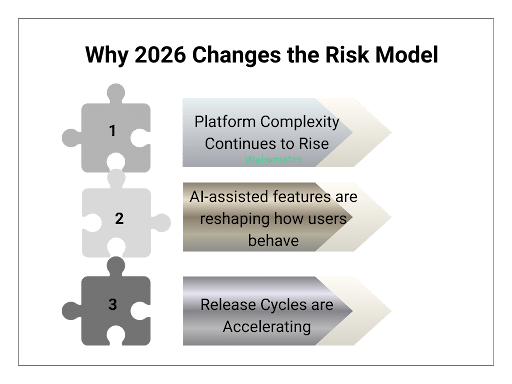
What’s different now is not a single failure mode. It’s the way multiple forces are converging to compound production risk faster than traditional automation can adapt.
There are three shifts that are happening at once:
- Platform complexity continues to rise
- AI-assisted features are reshaping how users behave
- Release cycles are accelerating
As a result, user behavior now evolves faster than test design.
Risk no longer grows linearly with code changes. It accumulates quietly between releases, even as automation coverage improves.
The pattern is already familiar to many engineering leaders:
Teams ship on schedule, then spend the next sprint recovering. That recovery cost does not always appear as defects. It shows up as:
- Lost roadmap capacity
- Emergency fixes
- Automation rework
- Support escalation
- On-call fatigue
High-performing engineering organizations outperform peers not by testing more, but by reducing late discovery. Teams that fall behind in behavior-driven validation increasingly drift into the mid or low-performing tier, where delivery efficiency erodes quarter by quarter.
Why Shift-Left and Shift-Right Are No Longer Enough
Most mature teams already practice both. Both still matter.
But they were designed for a simpler operating environment.
What Shift-Left Gets Right and What it Misses
Shift-left validates intended behavior:
- Requirements are reviewed
- Test cases pass
- Automation confirms designed workflows
What it assumes is ideal usage.
In production, users do not behave ideally. They behave efficiently, habitually, and under pressure. High automation coverage confirms what was designed, not whether those assumptions survive real-world usage.
And behavior-driven failures escape because they were never modeled.
What Shift-Right Reveals and Why It’s Too Late
Shift-right exposes failures after impact:
- Monitoring detects drop-offs
- Logs surface errors
- Alerts fire once users are affected
What it does not explain is:
- Why users abandoned a flow
- Why was a step misunderstood
- Why real workflows diverged from what was approved
By the time these signals appear, the cost has already been paid in lost time, disrupted delivery, and reactive engineering work.
The Hidden Time Cost Leaders Underestimate
Behavior-driven gaps rarely show up in dashboards. But they surface everywhere else:
- Sprint capacity lost to post-release fixes
- Engineers pulled into firefighting
- Roadmap commitments slipping
- Teams context-switching away from planned work
As systems scale, this time loss compounds. Engineering leaders increasingly spend cycles managing recovery instead of progress, even when teams followed approved processes.
That is why this becomes a leadership issue, not a QA one.
Shift-Everywhere: A Practical Evolution for Automation
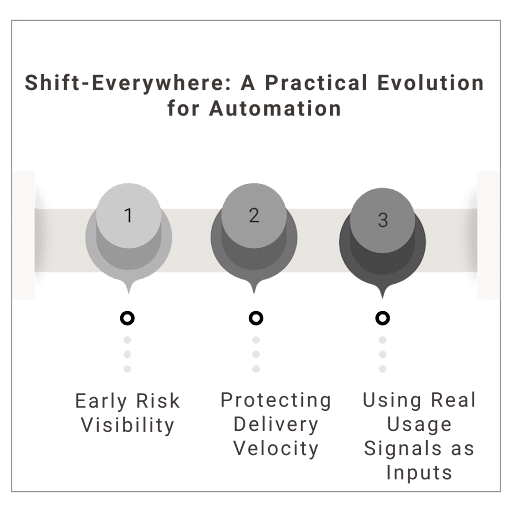
Shift-everywhere is not about running more tests. It is about expanding what automation validates and when, so teams identify risk while change is still cheap.
This evolution rests on three principles that directly protect delivery efficiency.
Early Risk Visibility
Shift-everywhere surfaces assumptions early:
- Where user behavior may diverge from design
- Where workflows rely on implicit knowledge
- Where late discovery would be expensive
The question shifts from:
“Did the test pass?”
to
“What assumptions did we just validate, or miss?”
When leaders have this visibility early, teams fix problems before they become recovery work.
Protecting Delivery Velocity
Late discovery is the enemy of velocity. When behavior mismatches are identified while features are still in flight, teams avoid:
- End-of-sprint delays
- Emergency fixes
- Repeated automation rework
Velocity is preserved not by moving faster, but by eliminating avoidable rework before it slows teams down.
Using Real Usage Signals as Inputs
Real user behavior reveals what automation alone cannot. It shows:
- Where workflows are abandoned
- Where steps are skipped under pressure
- Where unintended usage increases risk
For engineering leaders, these signals function as an early warning system, guiding where validation must evolve before incidents occur.
Why Usability and UAT Now Directly Affect Delivery Cost
Usability issues are not cosmetic. They are defect multipliers. When users hesitate or misinterpret actions, the downstream impact appears as:
- Support tickets
- Workarounds
- Slower adoption
- Rising operational load
Strong UAT validates whether systems support how work is actually done, not just how it was designed.
These gaps remain invisible to functional automation, but expensive once they reach production.
When This Becomes a Leadership Problem

At the executive level, these issues show up as:
- Missed commitments
- Rising operational cost
- Increased incident visibility
- Declining confidence in delivery forecasts
When behavior-driven gaps are discovered late, engineering leaders are forced to explain delays, even when teams followed every approved process.
Shift-everywhere becomes a control point, not a framework: a way to reduce avoidable recovery before it impacts delivery credibility.
What Engineering Leaders Change with Shift-Everywhere
Teams that adopt shift-everywhere operate differently:
- Automation is no longer isolated within QA
- Behavior-driven signals are reviewed alongside MTTR and failure rates
- Late-stage testing is no longer the primary risk strategy
- Investment shifts toward early visibility and continuous validation
Quality becomes a time-saving capability, not a reactive safety net.
Takeaway: A Clear Leadership Decision
In 2026, the competitive advantage belongs to engineering leaders who eliminate avoidable rework before it consumes delivery capacity.
The decision is no longer whether automation coverage is high enough. It is whether your automation model actively:
- Protects roadmap execution
- Reduces recovery cycles
- Preserves funded engineering capacity for forward progress
Teams that adopt early, behavior-driven validation consistently deploy faster, recover more efficiently, and free engineering effort for high-value work. Those who don’t will continue explaining delays despite doing everything right.
That is the real cost of late discovery.
In practice, these delivery challenges are commonly addressed by engineering teams using platforms such as Webomates to improve testing intelligence and visibility across releases
Ready to reduce late discovery before it slows your delivery?
Explore Webo.Ai to see how shift-everywhere works in practice, or Schedule a Demo to understand how it can fit into your existing automation strategy.
Shift-Left and Shift-Right Aren’t Enough Anymore
Late discovery of real user behavior is silently slowing your releases. Move to continuous intelligence and catch risks early—before they impact delivery.
FAQs
- What is shift-everywhere testing, and how is it different from shift-left or shift-right?
Shift-everywhere is a way of thinking about risk, not just where testing happens.
Shift-left helps teams validate what they plan to build before code is written. Shift-right helps teams understand what breaks after users are already impacted. Both matter, but both assume that risk appears at specific points in time.
Shift-everywhere recognises that many failures today do not come from broken code, but from assumptions about user behaviour that quietly drift in between. It focuses on continuously validating those assumptions during design, while features are in progress, and as real usage evolves, so teams discover risk while it is still cheap to fix.
- What are the real benefits of adopting a shift-everywhere approach?
When teams identify behaviour mismatches early, they avoid the hidden work that usually follows a release: emergency fixes, automation rework, support escalations, and engineers pulled off planned work. That time loss rarely shows up as a single defect, but it steadily erodes velocity sprint after sprint.
Shift-everywhere helps teams surface these risks before they turn into recovery work. It allows engineering leaders to preserve roadmap execution, reduce post-release rework, and keep funded engineering time focused on forward progress instead of correction.
- How do teams continuously understand real user behaviour without waiting for production incidents?
Teams don’t rely on a single signal. They combine multiple sources to see where assumptions may break down.
Usability sessions and UAT reveal where users hesitate or misunderstand flows before release. Analytics and usage patterns show where steps are skipped or abandoned. Support signals and operational feedback highlight where friction quietly accumulates.
What matters is not collecting more data, but feeding these signals back into validation early, while features are still changeable. When behaviour signals are reviewed alongside delivery and stability metrics, teams can adjust workflows and validation strategies before those gaps turn into incidents or recovery cycles.
- Why does usability testing matter so much in a shift-everywhere model?
When users misinterpret labels, skip steps, or rely on workarounds, the impact doesn’t always appear as a bug. It appears later as support load, slowed adoption, repeated fixes, and operational drag. Functional automation can confirm that a workflow works as designed, but it cannot confirm that it works as users actually behave.
Usability testing exposes these gaps early. It helps teams correct assumptions before they harden into delivery risk, reducing the likelihood that small misunderstandings turn into expensive post-release rework.
In a shift-everywhere model, usability is not a design concern; it is a cost-control mechanism.
Aseem, Founder & CEO of Webomates, created Webomates CQ, an AI-driven testing platform that cuts testing time by 10x with AiGenerate , and accelerates test maintenance by 10x using AiHealing, with guaranteed 24-hour execution. A multi-technical Emmy award winner with AI automation patents, he writes about AI-first testing and faster, simpler software delivery.
Tags: AI Testing, Automation Testing, continuous intelligence, engineering leadership, production risk, Shift Left Testing, Shift Right Testing, Test Automation Strategy
Leave a Reply