
Accelerate Success with AI-Powered Test Automation – Smarter, Faster, Flawless
Start free trial
For years, QA success was measured by a single factor. The number of tests that passed or failed. Green meant “good,” red meant “bad,” and everyone moved on. But in today’s fast-paced, AI-powered development world, testing is no longer just about code quality, but about business value. Every release impacts customer experience, brand reputation, and revenue. So the real question isn’t “Did all tests pass?” but “Did this release help us achieve our business goals?”
This shift is evident in the growing adoption of outcome-based testing metrics. Forward-thinking companies are moving beyond traditional pass/fail metrics to focus on measurable business outcomes. For instance, organizations are increasingly prioritizing metrics that directly correlate with customer satisfaction, revenue impact, and operational efficiency.
Outcome-based testing metrics bridge the gap between QA performance and business success, focusing on measurable impact rather than technical stats.
The Problem with Conventional Testing Metrics
Traditional metrics like test coverage, defect count, and pass/fail ratios have their place. They tell us how testing is performing, but not how much value it’s delivering.
For example, a 99% pass rate sounds great, but if customers still face glitches or downtime, what does that really mean? You might detect 500 defects, but how many of them actually impact end-user experience or business continuity?
These metrics are internally focused. They measure testing efficiency, not testing effectiveness. In 2026, that’s a blind spot most businesses can’t afford.
Redefining Testing Success: From Technical to Business KPIs
To stay competitive, QA teams must align their metrics with business outcomes.
According to a recent World Quality Report, over 70% of organizations are now prioritizing quality metrics linked to customer experience and business value rather than defect counts or coverage percentages.
This evolution reflects a growing recognition that QA success is measured not by how many bugs are found, but by how much business value is delivered.
Here are key business-aligned testing metrics that matter today:
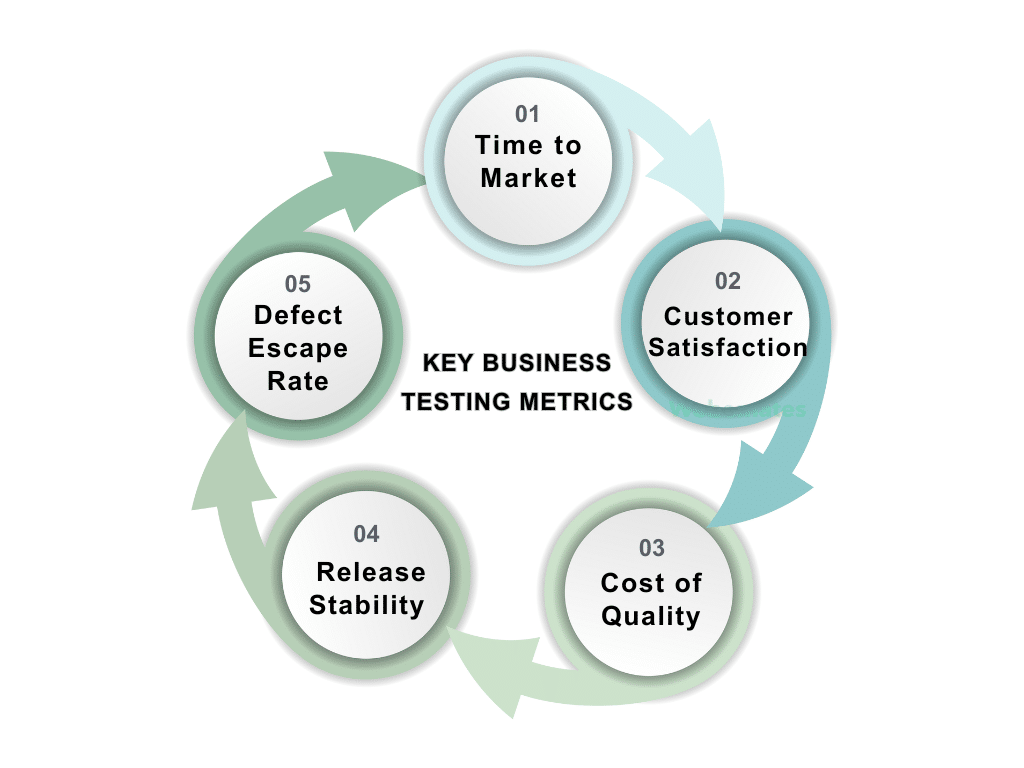
1) Time to Market: Measures how efficiently testing enables faster, confident releases.
2) Customer Satisfaction (CSAT/NPS): Reflects the true perception of quality as experienced by users.
3) Cost of Quality: Balances investment in automation, AI, and test coverage against production defect costs.
4) Release Stability: Tracks post-release incidents, rollbacks, or downtime.
5) Defect Escape Rate: Shows how well QA prevents defects from reaching production.
Each of these metrics ties testing outcomes directly to business performance and customer value.
How AI and Automation Are Enabling Outcome-Based Testing
AI has changed the game for QA. More than speeding up test execution, it’s helping teams predict and measure outcomes that impact the business.
For instance:
1) Predictive defect analytics: can forecast which modules are at the highest risk before release.
2) AI-driven dashboards: can correlate test execution data with production incidents.
3) Automation intelligence: can optimize test selection to reduce cycle times and improve release readiness.
By combining AI with automation, organizations can continuously connect QA metrics with business goals like customer retention, uptime, and faster innovation.
Case in Point: Business-Aligned QA in Action
A leading European fashion retailer introduced AI-generated test scenarios, achieving a 60% faster release time and an 84% reduction in critical production bugs after shifting to AI-powered testing. By shifting from test pass/fail metrics to business outcomes, the QA team began measuring release stability and time to market, rather than just coverage.
A report on AI-first testing in enterprises states that one retail client with 43 apps “could replace 90% of their testing work with our AI” and achieved significant business value.
By aligning testing success with business KPIs, QA transformed from a reactive cost center into a strategic enabler of growth.
Building a Framework for Outcome-Based Testing
To make this transformation work, organizations need a clear framework. Here’s how to get started:
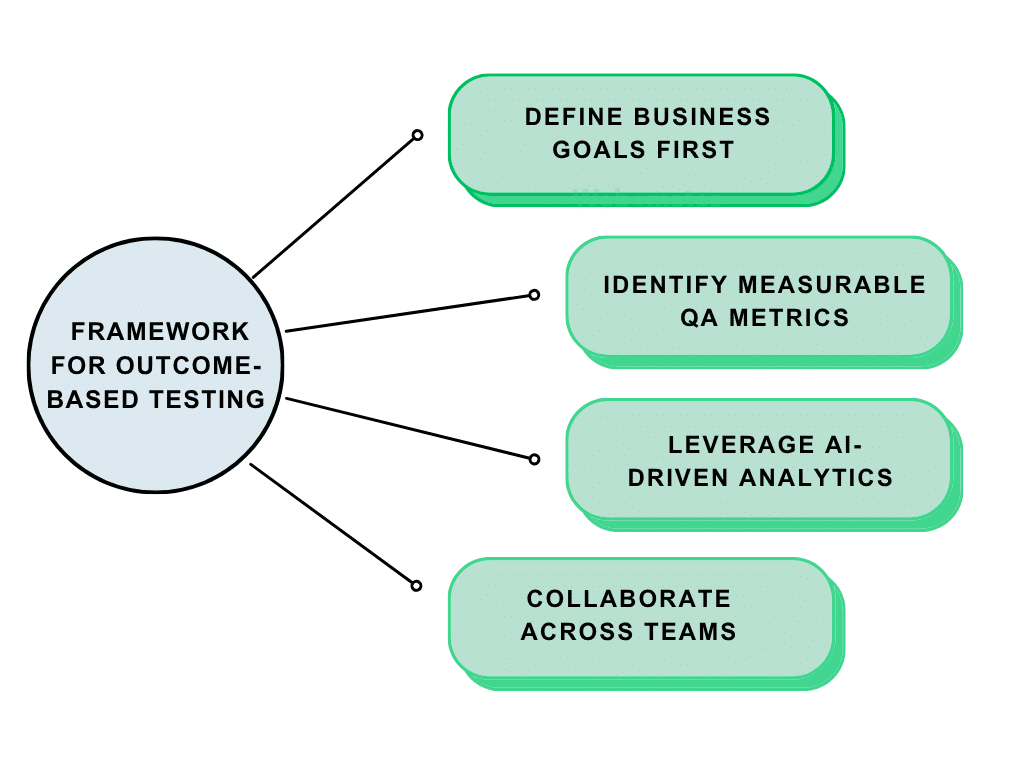
1) Define business goals first. Start with what the product or release aims to achieve customer retention, revenue growth, or faster time to market.
2) Identify measurable QA metrics that support those goals. For instance, link test cycle efficiency to release frequency.
3) Leverage AI-driven analytics to track and visualize these metrics in real time.
4) Collaborate across teams. QA, product, and business leaders must jointly own success criteria.
This approach ensures that testing isn’t operating in isolation; it’s directly contributing to business success.
The Future of Testing Metrics
As QA becomes increasingly intelligent, the way we measure success will evolve, too.
Future testing metrics will be:
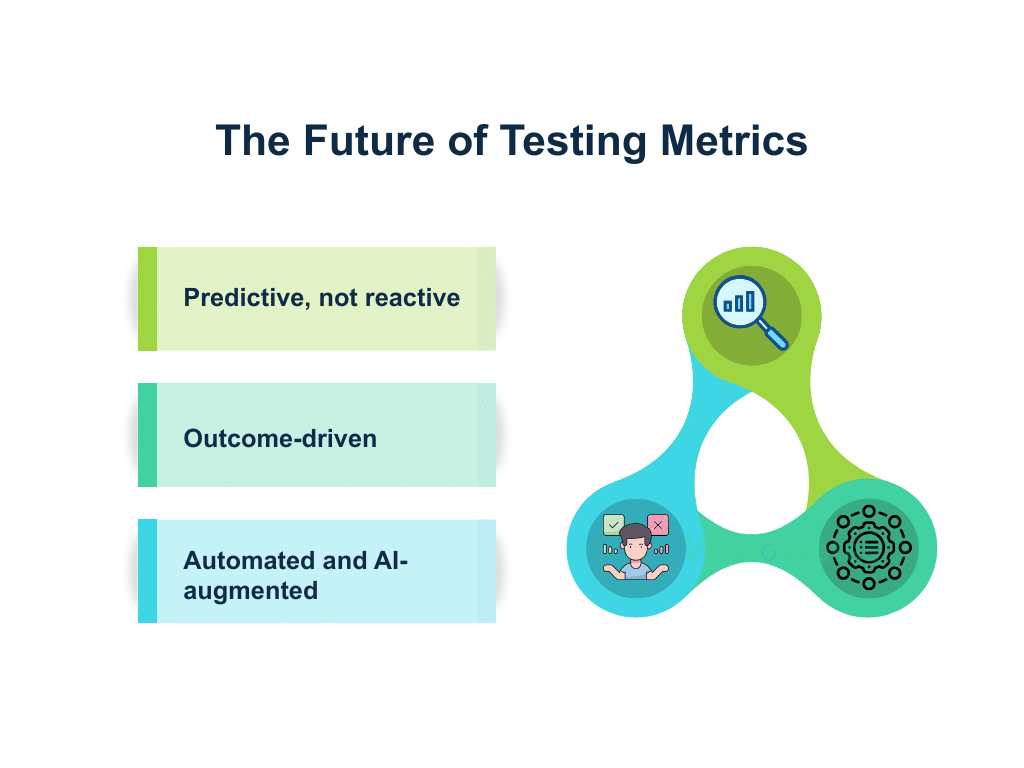
1) Predictive, not reactive: anticipating risk before it happens.
2) Outcome-driven: tied to user experience, revenue impact, and release confidence.
3) Automated and AI-augmented: with real-time dashboards that connect test data to business analytics.
In this future, QA leaders won’t report on test counts; they’ll report on business impact per release.
Quality Is a Business Strategy
The era of binary pass/fail testing is over. Modern QA teams have a far greater mission to ensure every release adds measurable business value.
By adopting outcome-based metrics, organizations can transform testing from a technical checkpoint into a strategic driver of success. Because at the end of the day, testing isn’t just about validating functionality, it’s about validating business outcomes.
Measure QA by Business Impact—Not Just Test Results
Move beyond pass/fail metrics. Use AI-driven insights to track what truly matters—release quality, customer experience, and business outcomes.
✔ No credit card required | ✔ Get insights in minutes
Ready to move beyond pass/fail testing?
Webomates’ AI-powered testing platform helps you measure and deliver quality in business terms, faster releases, happier customers, and tangible ROI. Discover how outcome-based testing can redefine success for your organization.”
Explore Webo.AI to see how outcome-based testing works in practice, or Schedule a Demo to understand how it can align your QA metrics with your business goals.

Ruchika Gupta, COO and Co-founder of Webomates, has 20+ years of experience in product delivery and global tech operations. She has held key roles at IBM, SeaChange, IPC Systems, Birlasoft, and served as President of Fonantrix Solutions. She writes about scaling operations, building strong delivery teams, and enabling smarter testing practices.
Leave a Reply