
Accelerate Success with AI-Powered Test Automation – Smarter, Faster, Flawless
Start free trial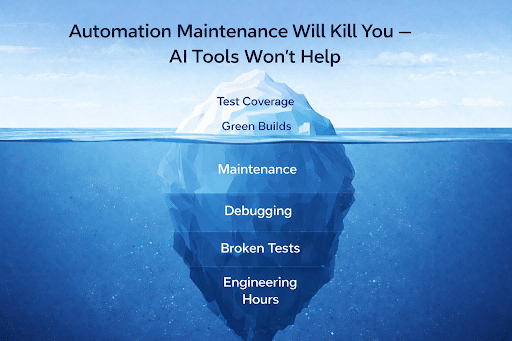



A few months ago, I sat in a review where everything looked fine. Coverage was high. Dashboards were green. Releases were going out.
Someone even said, “Automation is in a good place.”
Then one of the engineers said something almost in passing:
“We spent most of last sprint fixing broken tests.”
Nobody reacted immediately. Because it didn’t sound unusual.
That’s exactly how we get blindsided.
The Pattern Nobody Questions
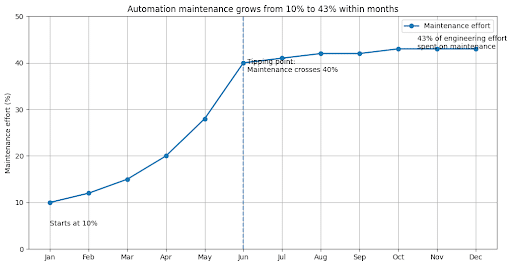
We went back and pulled a full year of data. 49 engineers. Over 64,000 hours. What we found was not a testing problem. It was a capacity problem. Nearly 1 in 4 hours of real product work was going into maintaining automation.
And it doesn’t stay there. At the start of the year, maintenance was around 10%. By mid-year, it crossed 40% of total effort.
Suddenly, the math stops working.
You’re no longer getting leverage from automation. You’re feeding it.
And this isn’t just what we saw. Across the industry, the pattern repeats. The World Quality Report by Capgemini shows that mature teams spend nearly three times more time fixing tests than creating them. And broader transformation benchmarks consistently show that most large initiatives fail to deliver expected ROI.This is a massive leak in our productivity that we’ve just been ignoring.
You Didn’t Plan for This (But You’re Paying for It)
No one plans for this. No roadmap says “allocate 30% of sprint capacity to fixing tests.” But it shows up anyway.
I’ve seen this play out the same way across teams. A test fails. Someone fixes a locator. The pipeline goes green. Next sprint, another set of failures. Different tests, same pattern. No one tracks it as a problem. It just becomes part of the job.
Until one day someone asks, “Why are we spending this much time on this?” and there’s no clear answer.
As teams grow, this becomes structural. For every two hours spent creating tests, one hour goes into fixing them. In some systems, maintenance exceeds creation entirely.
Your automation is lying to you- and you don’t know it yet
I’ve looked at dashboards that were completely green while the team was debugging a production issue that should have been caught. The tests had passed. The product hadn’t.
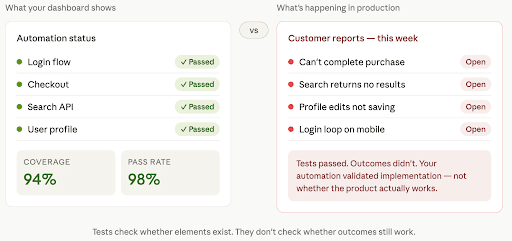
That’s not a contradiction. That’s how most automation systems behave.
Tests continue passing while validating outdated behavior. UI automation checks whether elements exist, not whether outcomes still work. Backend or API changes break real usage, but tests don’t catch it.
And when you zoom out, the impact is massive. The CISQ 2023 report estimates that poor software quality costs the U.S. economy over $2 trillion annually.
Teams do test but what’s happening here? They are testing the wrong things.
AI walked in promising to fix this. It didn’t
Right now, every conversation in testing comes back to AI. Tools like ChatGPT, Claude, and Gemini can generate test cases, write scripts, and even help debug failures.
And to be fair- they’re good at it.
You can create tests faster than ever before. Coverage looks better. Initial setup takes less time. But that’s not where most of the effort goes. The real cost of automation isn’t creating tests.
It’s maintaining them.
And this is where these tools fall short.
They don’t understand how your product evolves.
They don’t track what changed between releases.
They don’t adapt when workflows shift or behavior subtly breaks.
The tool generates the test. Your engineer fixes it when it breaks. That dynamic doesn’t change just because the test was written faster.
The Question That Changes the System
At some point, we stopped asking, “How do we fix this faster?” and started asking, “Why are we fixing this so often in the first place?”
Most automation today is validating implementation. Did the button click? Did the step execute?
That works until anything changes.
Stronger systems validate outcomes. Did the intended result happen?
Because implementation changes constantly. Outcomes don’t.
We built Webomates because we couldn’t find a solution that attacked maintenance itself -only tools that made creation faster.
This Is the Gap We Built Webomates For
Instead of creating more tests and fixing them faster, we focused on removing the dependency on scripts altogether. Instead of tying validation to implementation, we moved to outcome-driven systems that adapt as the product changes.
In practice, that means no locator fixes, no script rewrites after UI changes, and no sprint time spent debugging broken automation.
Not reduced to zero- but removed as a recurring burden inside every sprint.
What This Looks Like in Practice
Rackspace, a $2B managed cloud company, was running 14 enterprise applications with the same pattern- tests breaking, engineers fixing locators, pipelines going green, repeat.
When they moved to an outcome-driven approach with Webomates, 1,450 test cases were generated across browsers, mobile, and APIs in four weeks.
But the more significant outcome wasn’t the test count. It was what their engineers stopped doing.
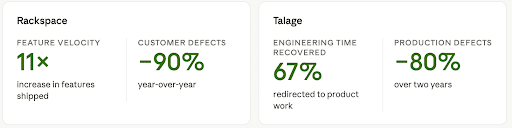
With tests that adapted to product changes rather than breaking on every UI update, the development team redirected that recovered capacity toward actual product work. The result was an 11× increase in feature velocity and a 90% reduction in customer-discovered defects year over year.
That’s the kind of shift that actually moves the needle on our bottom line.
Talage, an insurance tech firm operating on aggressive release cycles, saw the same pattern. Two-thirds of their QA team’s time, previously consumed by maintenance and firefighting, was redirected to higher-value work. Testing effort dropped by 67%, and production defects fell by 80% over two years.
Their test suite kept pace with every release automatically- not because engineers were fixing it sprint by sprint, but because the system adapted as the product changed.
Your Competitor Isn’t Waiting
No one loses because of one bad release or one slow sprint.
They lose because, over time, someone else keeps moving slightly faster.
Every sprint your team spends maintaining automation:
- Someone else is shipping
- Learning faster
- Improving faster
And that compounds.
This isn’t about one missed deadline.
It’s about compounding loss of velocity over time.
What You Should Do Next
If your team is spending a meaningful part of every sprint maintaining automation, this isn’t something to revisit next quarter.
It’s already costing you speed.
Start by answering two simple questions:
- How much engineering time is actually going into fixing tests every sprint?
- Are your tests validating outcomes- or just implementation?
Most teams don’t have a clear answer to either. If you can’t answer those two questions, you’re flying blind.
If you want to see what a system looks like where maintenance doesn’t show up every sprint, take a look at how you’re actually spending your engineering hours. Do it now, before you lose another quarter to the maintenance treadmill.
Stop Losing ROI to Test Maintenance
Flaky tests, broken selectors, and endless fixes are slowing you down. Switch to self-healing, AI-powered automation that actually scales with your product.
FAQs
1. How much engineering time should realistically go into test automation maintenance?
Industry benchmarks suggest healthy teams keep automation maintenance below 15–20% of total QA effort. If your team is crossing 30–40% per sprint, that’s not a process problem -it’s a structural one. At that point, you’re no longer getting ROI from test automation. You’re subsidising it.
2. Why do automated tests keep breaking even when the product hasn’t changed significantly?
Most test automation is tied to implementation details -specific locators, UI element positions, or API response structures. When anything shifts, even minor refactoring, those flaky tests break. The scripts aren’t fragile because of bad engineering. They’re fragile because they’re measuring the wrong thing. This is the core reason AI testing tools that focus on test creation don’t solve the maintenance problem -the underlying approach stays the same.
3. Can AI tools like ChatGPT or Copilot actually reduce test maintenance effort?
They reduce the time it takes to write tests. They don’t reduce the time it takes to fix them. AI generates scripts faster, but those scripts still break when the product changes -and your engineer still has to debug and rewrite them. Creation speed and maintenance burden are two entirely separate problems, and most AI test automation tools only address the first one.
4. What is outcome-driven testing and how is it different from traditional automation? Traditional automation validates implementation -did this button get clicked, did this step execute? Outcome-driven testing validates results -did the user journey complete successfully? The distinction matters because implementation changes constantly while business outcomes stay stable. A QA automation strategy built around outcomes means your tests survive product changes instead of breaking on every release cycle.
5. What is test debt and how does it affect engineering velocity?
Test debt is the accumulation of broken, outdated, or unmaintained automated tests that no longer reflect how the product actually works. Like technical debt, it compounds quietly -teams carry it sprint to sprint, spending more hours fixing old tests than shipping new features. Left unaddressed, test debt becomes one of the biggest hidden drags on engineering velocity, and it rarely shows up in planning conversations until it’s already a crisis.
6. How do I calculate the ROI of test automation for my team?
Start simple: track hours spent creating tests vs. hours spent maintaining them over one sprint. If maintenance is eating more than 20% of your QA effort, your test automation ROI is already being eroded. Then factor in defect leakage -each production defect typically costs 4–5x more to fix than one caught pre-release. If your automated tests are missing issues that reach customers, the cost of poor software quality is compounding on both sides.
7. What is self-healing test automation and does it actually work?
Self-healing test automation refers to systems that automatically adapt when the product changes- adjusting to UI updates, workflow shifts, or structural changes without requiring engineers to manually rewrite scripts. Instead of tying tests to implementation details that break, self-healing systems anchor validation to outcomes. At Webomates, we have patented AiHealing® technology, which help test suite stay current across releases without sprint time going into maintenance. The Rackspace and Talage results we shared above are real examples of what that shift looks like at scale.
8. At what team size does automation maintenance become a serious problem?
It tends to become structural around 20–30 engineers, when the test suite is large enough that no single person understands all of it and changes in one area start causing unexpected failures elsewhere. By the time you’re at 40–50 engineers running multiple applications, QA automation maintenance can consume a quarter of all engineering hours -pulling capacity away from product work and quietly killing engineering productivity. Our own data across 49 engineers and 64,000 hours confirmed exactly this pattern.

Aseem, Founder & CEO of Webomates, created Webomates CQ, an AI-driven testing platform that cuts testing time by 10x with AiGenerate , and accelerates test maintenance by 10x using AiHealing, with guaranteed 24-hour execution. A multi-technical Emmy award winner with AI automation patents, he writes about AI-first testing and faster, simpler software delivery.
Tags: AI Testing, Automation Maitenancce, Automation Testing, DevOps, QA Challenges, Self Healing Automation, Software Testing, Test Automation
Leave a Reply