
Accelerate Success with AI-Powered Test Automation – Smarter, Faster, Flawless
Start free trial



Agile delivery models have accelerated release cycles across engineering organizations. In competitive SaaS markets, faster iteration is not optional; it directly affects revenue expansion, customer retention, and market position.
Yet while delivery models have evolved, many QA organizational structures have not. Automation is mature, pipelines are reliable, coverage is broad, and execution is rarely the constraint. But at the moment of release approval, when engineering leadership must assume production risk, decision clarity is often incomplete.
When QA outputs require interpretation rather than providing decision-ready signals, the constraint is no longer technical. It becomes operational. And at scale, operational ambiguity compounds into delivery risk.
How the QA Organizational Structure Drifted in Agile
Most QA organizational structures were built around phase-based ownership. Testing began after development sign-off, and quality assurance functioned as a validation stage before release.
When organizations adopted Agile delivery models, execution speed improved. However, role design, reporting lines, and accountability models often remained unchanged. As a result, QA inherited responsibilities designed for staged releases, even as delivery became continuous.
This misalignment shows up in predictable ways inside Agile QA organizations.
- Downstream Influence: In many Agile team structures, QA in Agile still engages after scope and timelines are committed. This limits early risk visibility and reduces influence over release decisions.
- Metrics Without Decision Context: Agile QA success is frequently measured through coverage, defect counts, and execution rates. These indicators reflect activity, but they do not always translate into executive-level release readiness.
- Gate-Based Thinking: Quality assurance often operates as a sprint-end checkpoint rather than as a continuous input into delivery strategy. Testing confirms completion, but it does not always enable confidence at scale.
When these patterns persist, Agile QA becomes reactive rather than predictive, limiting its ability to influence release confidence early in the cycle.
Why Agile Exposes the Weakness at Scale
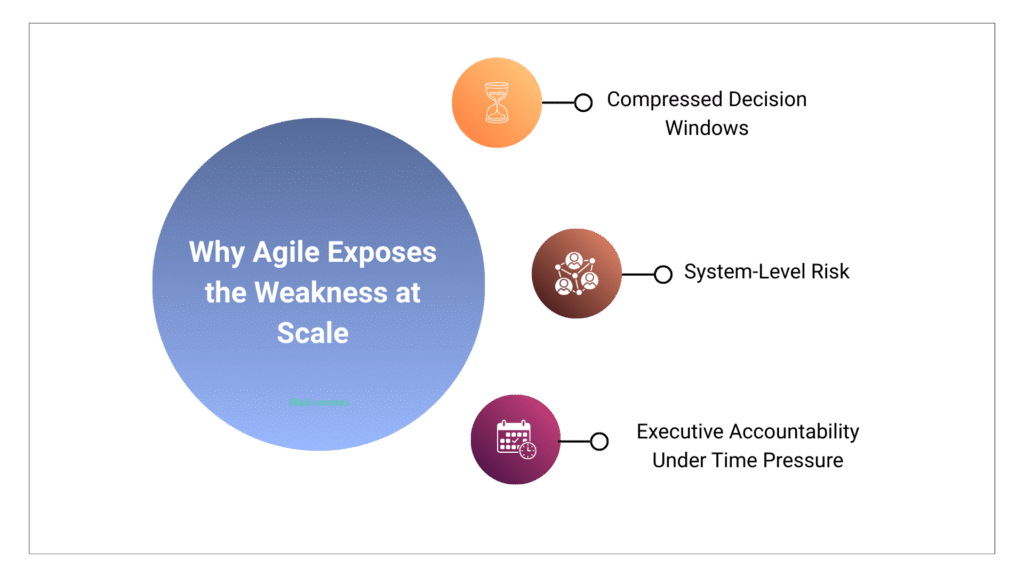
Traditional release models absorbed testing delays through schedule buffers. In a modern Agile delivery model, those buffers are gone. Shorter cycles leave little room for interpreting results late in the process.
As organizations scale Agile teams, gaps in Agile QA become more visible.
- Compressed Decision Windows: In high-growth environments, delayed or hesitant releases have measurable cost. A postponed feature impacts expansion revenue. A misjudged release risks production instability. When release approvals depend on manual interpretation rather than structured risk signals, engineering leaders absorb decision latency and sometimes decision liability.
- System-Level Risk: In integrated environments, small validation gaps can propagate quickly. Quality assurance in Agile must provide system-level readiness signals, not just regression outcomes.
- Executive Accountability Under Time Pressure: Engineering leaders are expected to approve releases faster and with broader exposure. When QA in Agile does not provide clear decision-ready signals, approvals happen with partial visibility.
As release frequency increases, many organizations begin reassessing whether their QA organizational structure truly supports modern Agile delivery. That reassessment is often the starting point for meaningful QA transformation.
Automation Solved Speed, Not Decision Clarity
Most organizations have strengthened their test automation strategy as part of their Agile delivery model. Execution is faster, regression cycles are shorter, and DevOps and QA integration is tighter.
However, as Agile QA expands across multiple teams and systems, the volume of test output increases significantly. More automation means more results, not necessarily clearer release signals.
Automation validates functionality. It does not automatically prioritize risk across interconnected services or translate findings into leadership-ready insight.
When QA in Agile is structured primarily around executing tests rather than communicating risk, engineering leaders remain responsible for interpreting what truly matters before approving a release.
At scale, this is where the limits of the existing QA organizational structure become operationally visible.
Signs Your QA Organization is Underpowered
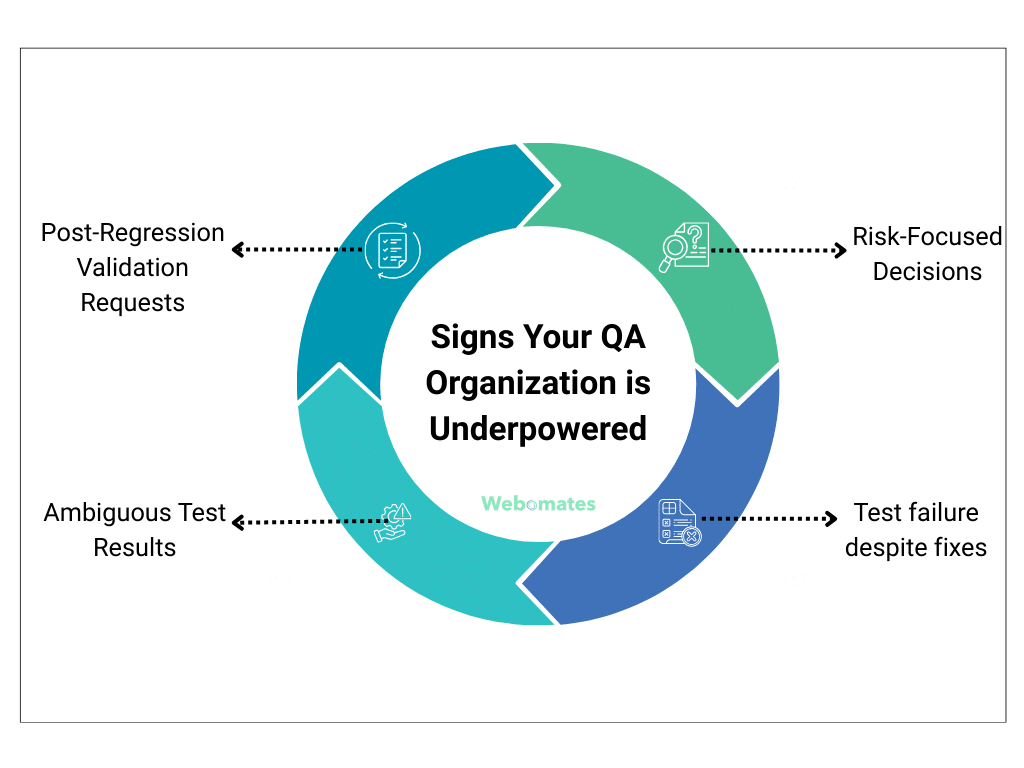
In modern Agile delivery models, structural gaps in Agile QA rarely appear as dramatic failures. They show up as recurring friction in release cycles.
Engineering leaders often notice patterns such as:
- Post-Regression Validation Requests: Late-cycle validation requests even after automated regression completes
- Ambiguous Test Results: Test results that require additional interpretation before a go or no-go decision
- Risk-Focused Decisions: Approval decisions focused on understanding risk rather than confirming readiness
- Test failure despite fixes: Clean test runs that still fail to generate full release confidence
Over time, these patterns affect more than sprint velocity. They influence how confidently leadership can scale teams, commit to roadmap timelines, and communicate delivery predictability to executive stakeholders. Structural ambiguity in QA does not remain isolated to engineering. It surfaces in strategic planning.
How Engineering Leaders are Adjusting
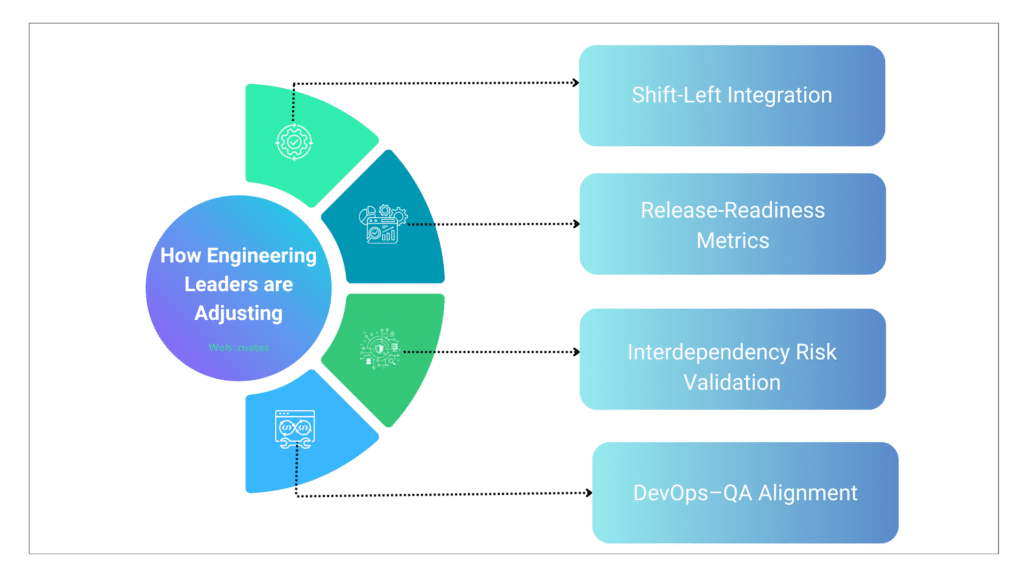
As Agile delivery models mature, many organizations are refining how Agile QA integrates into delivery rather than expanding tooling. Common shifts include:
- Shift-Left Integration: Bringing QA into Agile planning discussions before scope and timelines are finalized, so risk influences commitments early
- Release-Readiness Metrics: Moving measurement beyond test volume toward clear release-readiness signals aligned with business impact
- Interdependency Risk Validation: Improving visibility into regression risk across interconnected systems as Agile QA scales
- DevOps–QA Alignment: Aligning DevOps and QA outputs to provide decision-ready insight instead of raw execution data
These changes often begin incrementally. Instead of launching a broad QA transformation immediately, many teams start by evaluating whether their current approach to quality assurance in Agile supports leadership-level release decisions.
Conclusion
In high-velocity Agile delivery environments, release confidence becomes a strategic differentiator. Organizations that can scale automation but not decision clarity eventually encounter approval bottlenecks that limit growth.
The future of QA in Agile is not about increasing regression output. It is about converting execution into structured risk intelligence that engineering leadership can act on with confidence.
Platforms like Webomates are designed around this structural shift. By combining AI-driven automation with intelligent defect prioritization and decision-oriented reporting, the focus moves from test execution to risk clarity.
Instead of increasing regression volume, engineering leaders gain structured visibility into release readiness across teams and systems, reducing interpretation overhead at the approval stage.
Ready to move from execution-heavy QA to decision-ready release intelligence?
Explore Webo.AI or Schedule a Demo to see how decision-oriented QA scales with modern Agile delivery.
Your QA Isn’t Slow—It’s Underpowered
Test reports and metrics aren’t enough for Agile speed. Turn QA into a decision engine with AI-driven insights that give you real release confidence.
FAQs
- Why does QA fail in Agile environments?
QA rarely fails because of automation gaps. It struggles when the QA organizational structure remains optimized for staged releases instead of continuous Agile delivery.
In many Agile QA setups, testing activity scales, but decision alignment does not. When QA in Agile is measured primarily by coverage and defect counts rather than production risk exposure, leadership may still lack confidence at approval time. The issue is structural alignment, not test execution maturity.
- Which QA Team Structure Best Supports Scalable Agile Delivery?
For scaling Agile teams, a hybrid QA organizational structure works best.
Embedded Agile QA supports sprint speed and collaboration, while centralized oversight provides cross-system visibility and consistent risk alignment across the Agile delivery model. The goal is not choosing one model over the other. It is ensuring QA in Agile sustains release confidence as complexity grows.
- What are the problems with traditional QA in Agile delivery models?
Traditional QA in Agile often carries forward phase-based thinking, where testing follows development rather than shaping it. In a continuous Agile delivery model, this approach leads to late validation, limited early risk visibility, and approval hesitation despite completed sprints. The result is a gap between sprint output and true release readiness. These issues are rarely caused by tooling limitations; they stem from Agile testing organizational challenges embedded in legacy QA organizational structures.
- Is QA becoming obsolete in Agile and DevOps environments?
No. QA is evolving. As DevOps and QA integration deepens, the role shifts from manual validation to quality intelligence. The focus moves from detecting defects to signaling risk early and clearly.
Quality assurance in Agile becomes more strategic when it supports scalable release confidence rather than acting as a checkpoint.

Ruchika Gupta, COO and Co-founder of Webomates, has 20+ years of experience in product delivery and global tech operations. She has held key roles at IBM, SeaChange, IPC Systems, Birlasoft, and served as President of Fonantrix Solutions. She writes about scaling operations, building strong delivery teams, and enabling smarter testing practices.
Tags: AI Testing, Artificial Intelligence, Automation Testing, Intelligent Test Automation, Software Testing
Leave a Reply