
Accelerate Success with AI-Powered Test Automation – Smarter, Faster, Flawless
Start free trial
The Changing QA Landscape
Quality Assurance (QA) is no longer confined to writing test scripts or manual test cases or just finding defects. It is now a strategic function that ensures speed, resilience, and customer trust.
This is a new era of AI that helps QA to:
- Interpret the requirements and user stories
- Generate test cases and automation scripts
- Create synthetic test data
- Analyze results and defect patterns
- Refactor outdated or flaky test code
This is a paradigm shift that amplifies the capabilities. But as technology transforms, so too must the QA skill stack. Which skills will define the future?
Let’s explore the three pillars of this new QA competency model and how tools like Webomates CQ are helping organizations adopt this modern approach to quality.
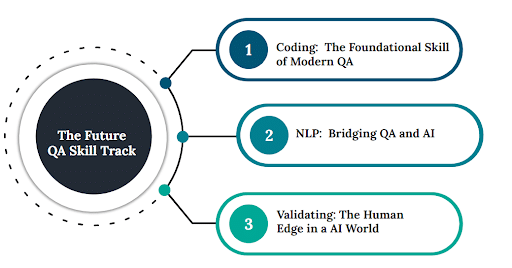
1. Coding: The Foundational Skill of Modern QA
AI tools can write test scripts, but testers who understand code will always lead the conversation.
Whether it’s Selenium or custom frameworks, coding remains essential to:
- Debug or refine AI-generated automation scripts
- Understand the impact of changes in the codebase
- Analyze and understand application and user behavior
- Review and refactor test logic
2. Natural Language Processing: Bridging QA and AI
Are you the debug-only QA of yesterday or the AI-enabled QA of tomorrow? NLP helps QAs to interact with AI-driven testing tools, bridging the gap between humans and machines, and striving for efficiency and innovation.
Modern QA tools powered by NLP (Natural Language Processing) can:
- Gather details from requirements or user stories
- Automatically generate test cases, ensuring that all scenarios are covered without any need for manual intervention.
- Analyze and identify different test scenarios. It helps in mapping the requirements to test cases, ensuring comprehensive coverage of all user stories and scenarios.
- Validate complex user flows
3. Validating: The Human Edge in an AI World
Intuition Is Irreplaceable. Even the most powerful AI is not immune to hallucination. Understanding domain context, specific application architecture details, risk, user behavior, and subtle UI/UX flaws still requires critical thinking that AI lacks.
AI is powerful, but it requires human oversight to ensure:
- Strategy aligns with business expectations or regulatory requirements
- Test unscripted paths and edge-case scenarios
- Test case structure and relevance
- Meaningful validation points
Validation keeps QA rooted in what matters most, and that is customer experience.
The Future QA Skill: Where Webomates Shines in This New Stack
The future isn’t about choosing between coding, NLP, or validating. It’s about mastering all three and knowing when to apply them.
Webomates has developed a practical approach to help developers and testers using AI in test automation. Our methodology considers the intricacies of using coding, automation, and human creativity in tandem.
Webomates CQ is one of the few platforms designed for this hybrid future:
- Coding. Webomates has achieved Amazon Web Services (AWS) DevOps Competency status. All testers have knowledge of the required technology and deep expertise to help customers add Continuous Testing to their existing CI/CD pipeline.
- Natural Language Processing. Create test cases based on product documentation or user stories, with no scripting needed.
- AI + Human validation. Internal quality reviews are a crucial step in Webomates’ process. Test cases are executed via automation, but human testers ensure review and oversight.
In addition to natural language test case creation and execution, Webomates also offers other AI-powered solutions that make your test automation smart.
The Bottom Line
By combining AI technologies like machine learning and NLP, teams can:
- Streamline processes: Automate tasks and reduce operational costs.
- Enhance customer experience: Create more intuitive interactions with stakeholders
- Drive Innovation: Embrace the latest testing trends and unlock hidden value and deliver transformative business outcomes.
It’s not just about saving time and effort; it’s about fostering innovation and improving the quality of applications, too!
Schedule a free demo or reach out to us at info@webomates.com.
Try our AI Based Test Automation Platform – Webo.AI
The Future QA Skill Stack Is Already Here
Move beyond traditional testing. Combine coding, AI-driven insights, and human validation to build smarter, faster, and future-ready QA processes.
✔ No credit card required | ✔ Get started in minutes
FAQs
No. AI can speed up testing by generating test scripts, finding patterns, and automating repetitive checks, but it cannot replace human validation. AI doesn’t have a complete understanding of context, business logic, and decision-making. Hence, testers are required to review and refine AI-generated test cases, validate results, catch false positives or missing scenarios, handle complex flows, and ensure that the product meets user expectations.
AI can assist in testing, but human validation is mandatory for accuracy and reliability.
AI can identify common defects and generate basic test scenarios at a good speed. However, its accuracy depends on the quality of data it is trained on, and also on the complexity of the application.
It performs well in structured and repetitive scenarios, but struggles when it comes to edge cases and usability issues. Hence, AI can be used as a support, but not as a sole decision maker in defect detection.
Yes. AI can write simple test scripts, but it cannot handle actual project needs like test logic, maintenance, debugging, and framework integration. When testers know coding, it helps them to control the way tests run, connect automation with CI/CD pipelines, customize tools, and attend to failures independently. If they rely on AI without coding skills, then they lose control over the testing process.
There are several tools that use Natural Language Processing (NLP) to convert plain English test steps into automated scripts. A few of them are:
- AiScriptBuddy – An upcoming NLP-based test automation tool from Webomates, which is expected to be fully functional by the end of November 2025. It converts natural language human-readable test cases to Selenium scripts with an estimated accuracy of 85-100%.
- TestRigor – Generates automation from human-readable test steps.
- Katalon Studio – Offers NLP-based test generation with AI assistance.
- ZencodeR – AI AI-powered test automation platform that uses NLP to create test cases from natural language instructions without requiring any coding.
Webomates is an advanced AI-powered Testing as a Service (TaaS) platform designed to automate test generation, execution, and maintenance. It leverages the power of Neural Networks, Natural Language Processing (NLP), and Generative AI to deliver intelligent, end-to-end testing at scale.
The platform uses AiGenerate to automatically create test strategies, test cases, and automation scripts without any coding effort. For automation stability, Webomates provides AiAutoHealing, which identifies and fixes around 70% of failures caused by locator changes or timeouts during execution. It also enables unlimited parallel test execution and integrates with CI/CD pipelines for continuous testing. AiHealing also handles ongoing maintenance by adapting tests to application changes after each release. It also maintains clear automation logs and provides video proof for each defect, ensuring faster validation and debugging—all within a 24-hour SLA.
By combining intelligent test generation, self-healing automation, and fast maintenance, Webomates CQ reduces scripting effort, minimizes flaky tests, and accelerates QA cycles with AI-driven efficiency.

Aseem, Founder & CEO of Webomates, created Webomates CQ, an AI-driven testing platform that cuts testing time by 10x with AiGenerate , and accelerates test maintenance by 10x using AiHealing, with guaranteed 24-hour execution. A multi-technical Emmy award winner with AI automation patents, he writes about AI-first testing and faster, simpler software delivery.
Tags: AI in QA, Coding in QA, Human Validation, NLP Testing, QA Skills, QA Transformation, Testing Automation
Leave a Reply